40 years Of Of The Folky
A History of the Illawarra Folk Festival
Written by Helen Wilson
The 40th Illawarra Folk Festival at Bulli Showground in January 2027 is something to celebrate – a story of dedication, determination and survival when so many other music festivals have come and gone.
The 40th Illawarra Folk Festival at Bulli Showground in January 2027 is something to celebrate – a story of dedication, determination and survival when so many other music festivals have come and gone.
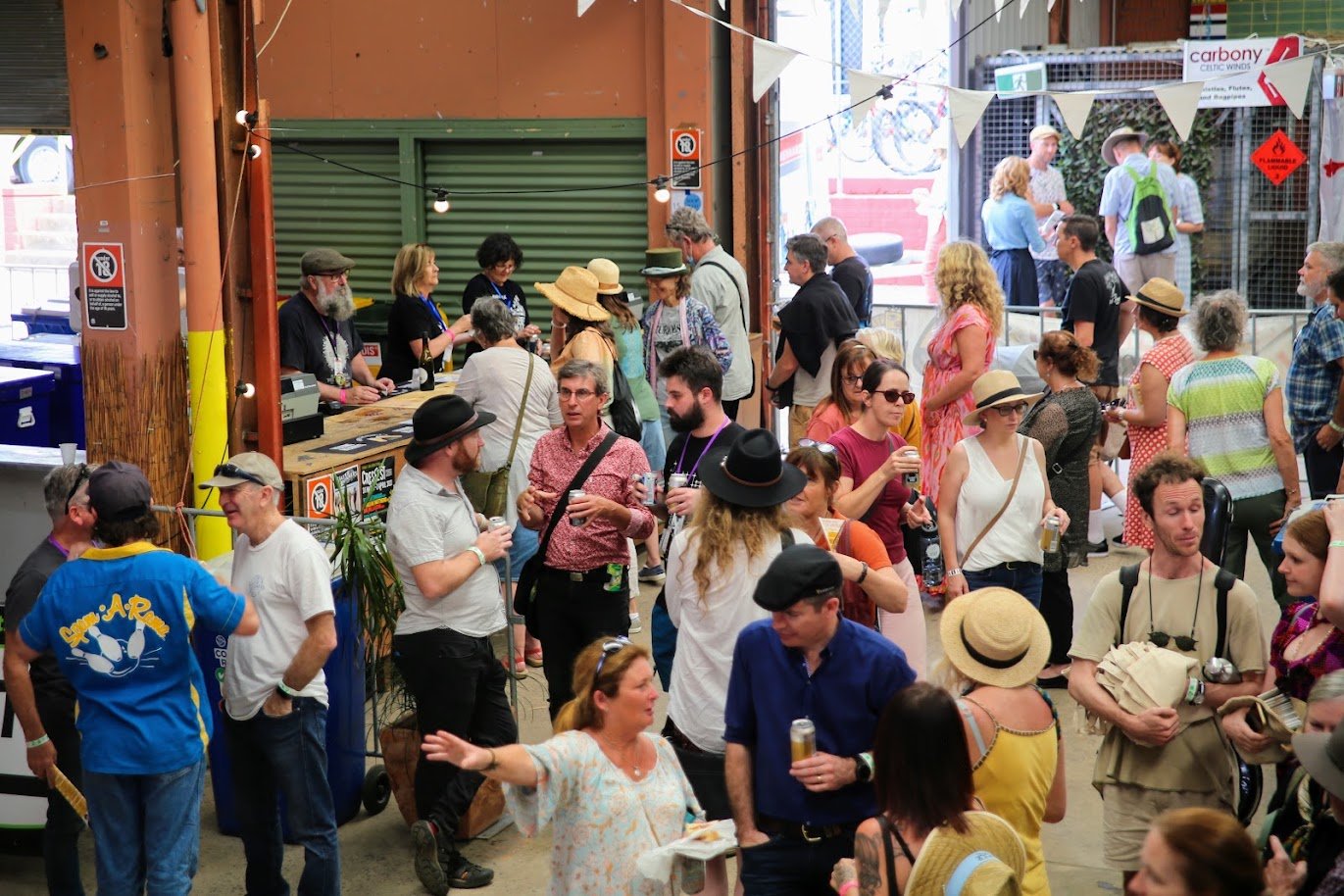
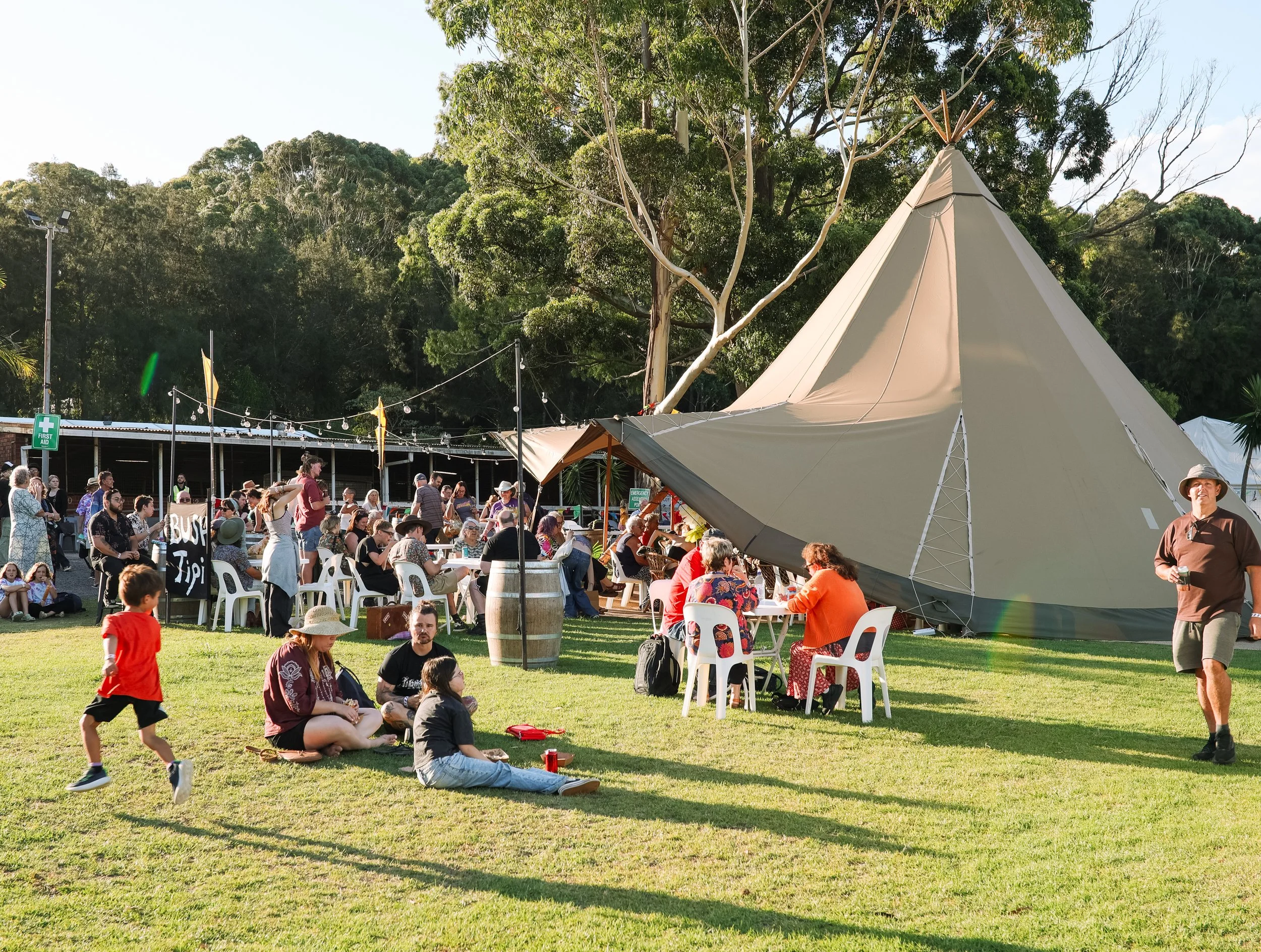
The festival’s history is defined by two main eras, based on two sites - first Jamberoo and then Bulli, at opposite ends of the Illawarra region. Jamberoo is a rural village in a picturesque valley at the foot of the escarpment while the Bulli site is a rundown showground in Wollongong's northern suburbs, currently leased to the greyhound racing industry. The story is also about the progression from a modest event largely based on Australian bush music and dancing to a large celebration of many musical styles.
Some elements and people have been constant but there has also been expansion and innovation. There's also been adaptation to the many challenges that festivals face, and its reinvention after the COVID-19 Pandemic, which forced the cancellation of the 2021 and 2022 festivals.
The Illawarra Folk Club runs the festival. The folk club was founded in 1979, holding regular concerts and events mainly at the Wollongong Tennis Club at Beaton Park and the Wollongong Ex-Services Club (later City Diggers Club) in the city. The folk club’s first festival, which started this great tradition, was held at Wilton west of Wollongong in 1985, in conjunction with the Bankstown Folk Club and the New South Wales Folk Federation.
As one of the club founders and satirical poet Russell Hannah explains, there was a great bush band revival in the 1980s. The Bushwhackers had established the tradition in Australia in the ’50s and ’60s and a new Bushwackers Band emerged in 1970. Russell says the Illawarra had about five bush bands - the North Bulli Bush band, the Wongawilli Bush band and others, and the Wilton festival was largely built around bush dancing. David De Santi, the person most responsible for the festival's later development, attended this festival as a young music enthusiast, but not as a performer.
Jamberoo 1986 - 2004
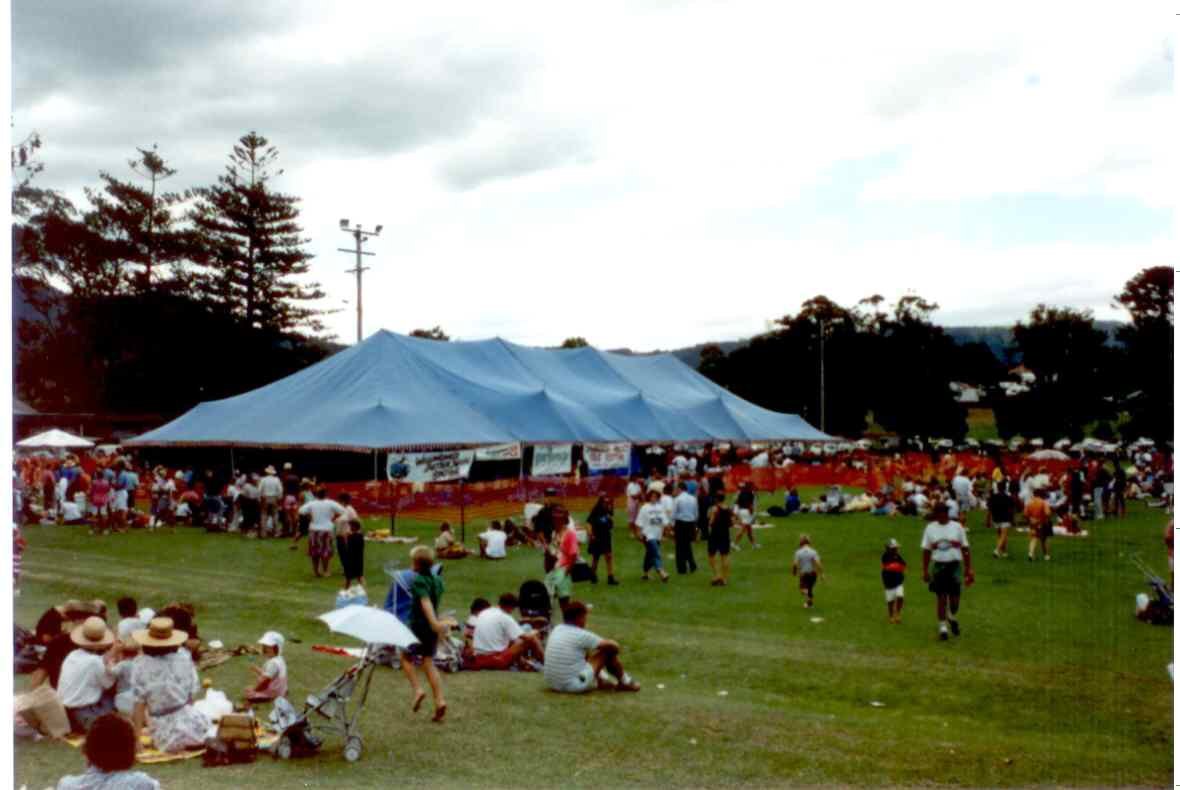
Russell remembers after the Wilton festival the Illawarra Folk Club decided it could stage future festivals on its own. “We said, well hang on, we can probably do one of these ourselves. But we thought, where on earth? How would we put it on?” he said. “Now, if you want a festival, we really wanted it where there's a bit of ambience. We looked around and we came up with the idea that Jamberoo would be a good place, so we went out and had a look. The Jamberoo pub also had a bush band every Sunday afternoon, so that worked out really well. Our first Jamberoo Valley Folk Festival was in March 1986.We used the RSL hall and the Youth Hall, both opposite the pub. And we used the School of Arts for the dancing and we used the pub. People camped down by the creek there, not an official camping ground, but the council let us do it. But not many people came. The folklore of the club is that there were 18 tickets sold and, and 12 of them were to the committee! I remember a bloke saying to me in the pub, is there something on here today?' It was a modest beginning.”
David De Santi had learned the accordion as a child of a migrant family and later took to bush music, playing at folk club events. He remembers the Jamberoo hotel as a venue for bush music. “On Sunday afternoon people like Alan Musgrove and the Lizard Dust Bush Band used to play there a lot with Johnny and Peter Harkin. These guys were part of the original Bertie McKnight group (Bertie's daughter Aisha now manages the festival office).”
David, Seamus Mackie and John Hartley started the Illawarra Bush Music Club, modelled on the Sydney Bush Music Club. “Somehow Seamus arranged for us to play at the first Jamberoo Valley Folk Festival,” David said. “Most of the performers were local or from Sydney.”
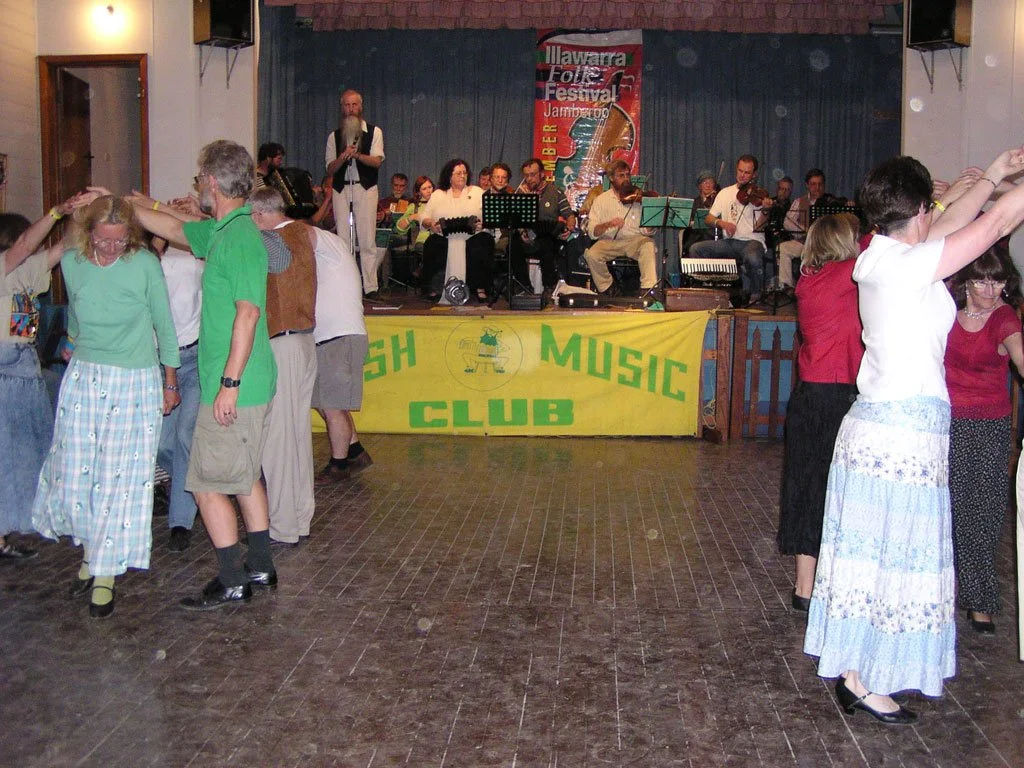
Bush Music Club at an early festival
The Bush Music Club transitioned into the Wongawilli Colonial Dance Club, a parallel organisation to the folk club, and the Wongawilli bush band, led by David for many years and a fixture at many later festivals, started out of that in 1986.
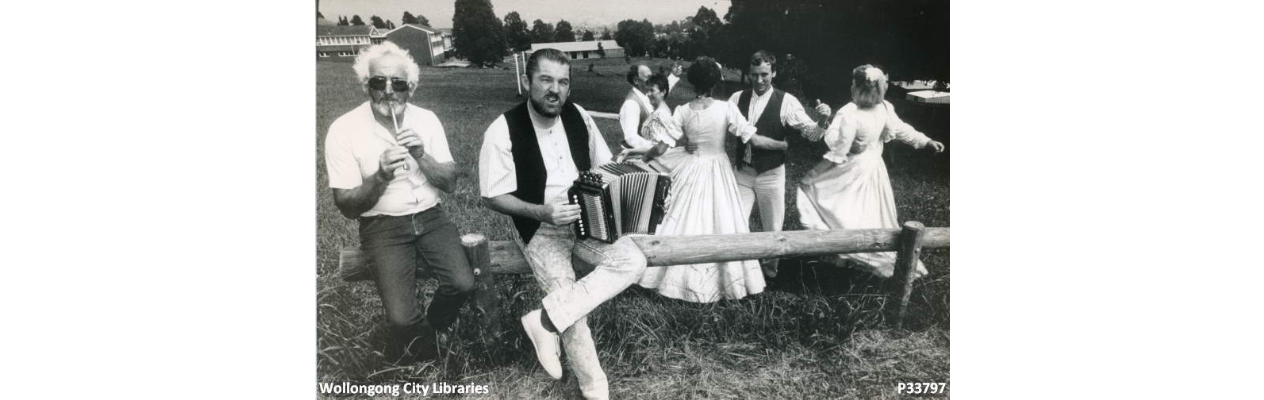
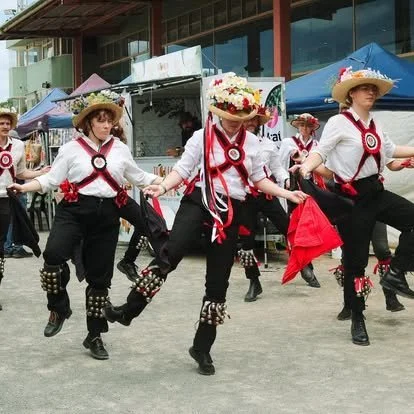
Wongawilli dancers
Russell says the early festivals were quite informal. “It was like the sessions we have up at Thirroul these days - people just came and basically played. We did have a program, but it wasn't lengthy. We might have had one concert on a Friday night, one little concert. Then we used two or three of the venues, and in the afternoon we used the back of the pub,” he said.
Russell was folk club president from 2003 to 2025, writing all the welcome messages in the program booklets as they developed. He's now a club elder who continues to play a prominent role in organising club concerts and selecting artists for the festival.
As the festival started to grow, artist Kathryn Orton got involved designing some of the early posters. She remembers: “My favourite poster was from the 1992 Festival at Jamberoo and it’s basically similar to a lino cut image. It’s just black and white and it’s got some of the traditional instruments in it. I did it as a scraper-board artwork, and it’s simple and bold and clear. That’s what you aim for, you know, a clear message.” She was one of many who loved the Jamberoo setting. “There was a nice old-fashioned pub, and across the road was this lovely little park that opened out onto a big football oval. And as the folk festival grew and grew, the oval got taken over with tents and marquees. It was really lovely when the festival was at Jamberoo. It was smaller, but each year it got a bit bigger.”
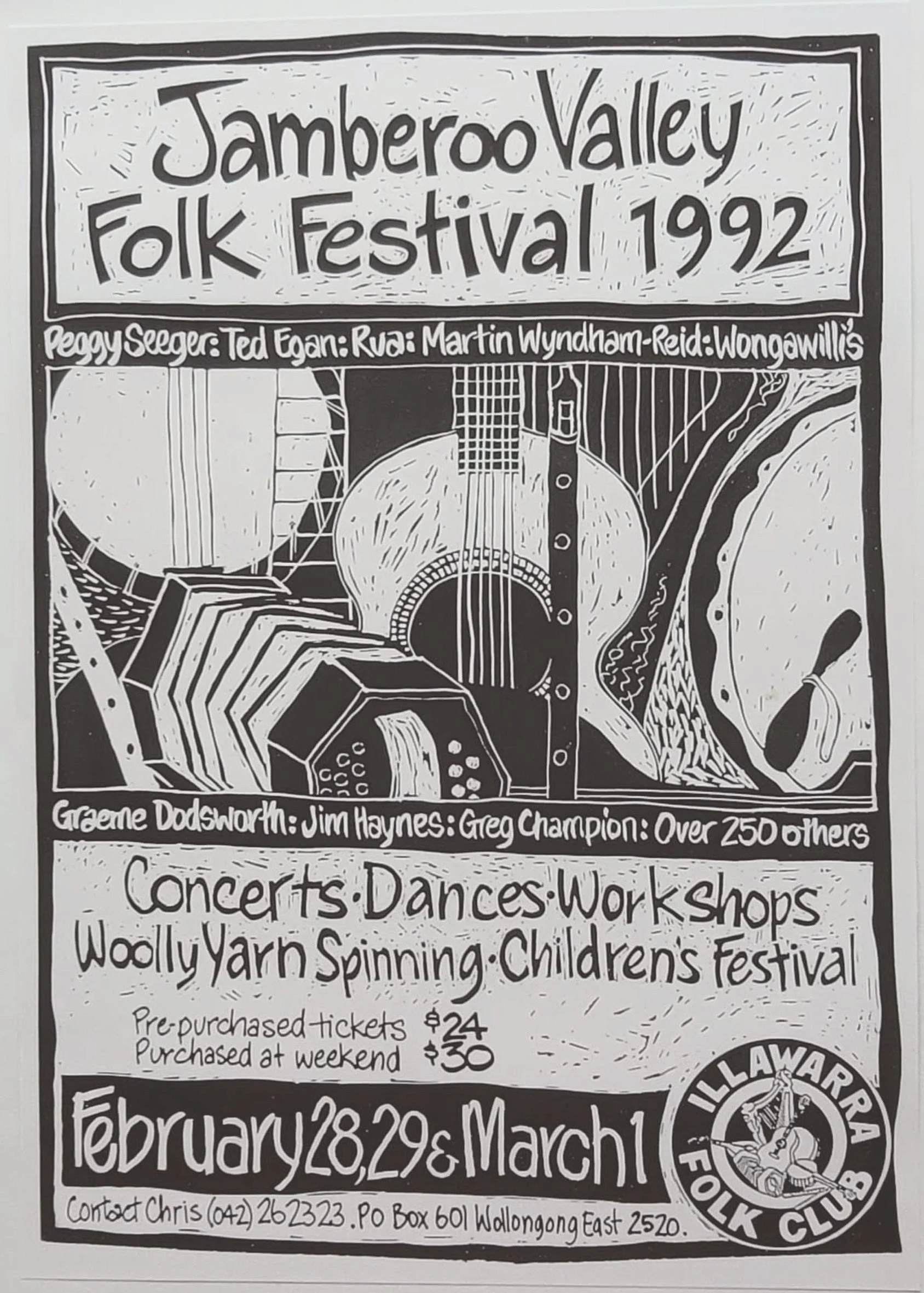
1992 Poster
David De Santi joined the committee in 1987 after enjoying the first festivals and club concerts. John Hartley and Chris Cartledge were early festival directors between 1989 and 1996, but Russell Hannah was the main person booking artists from the beginning. David helped with the scheduling and programming and getting printing done through his steelworks employer AIS (later BHP then BlueScope) which had a print shop. David arranged for the printing of posters, flyers and the program book, and says: “I'd sit with Russell making those early programs. We'd cut and paste things, type them up on his Mac. I'd set up sheets with the grids and take them to the print shop. That went on for quite a few years and then the shop closed. BlueScope then became a cash sponsor and has supported the festival ever since.”
Russell says the 1988 festival was the “watershed moment” that put the Illawarra Folk Festival on the map. “The Folk Club had had some big concerts at the Diggers Club. We had Eric Bogle and with Eric you pack the place out … and then another concert that year we had Ted Egan and he packed the place out,” Russell said. “I said to Eric: ‘Would you consider coming to this little festival that we've got?’ I said we could only offer him $500, and he said yes. And then I said to Ted at the later concert, will you come for $500? And he said of course he’d come for $500.
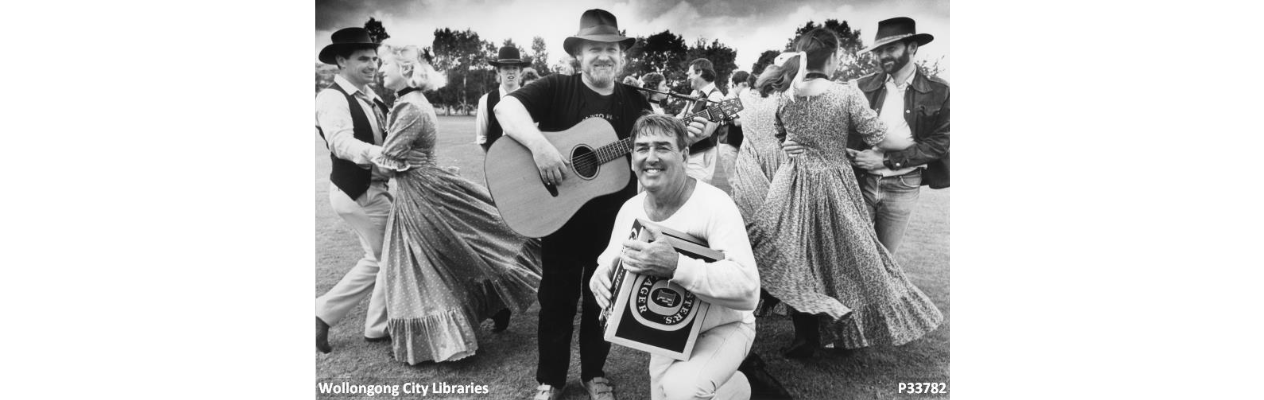
Eric Bogle and Ted Egan 1988
“We thought, well, they packed the place out in Wollongong, we'd better do something about having a suitable venue for them because the biggest venue we had would hold about 80. We told Go Hire we wanted to hire a tent for the Sunday. Then we had to pay Go Hire upfront because they didn't know us, so we raked up all the money we could to hire the tent. Then they said to us: 'Look it costs us too much money in wages to put the tent up on a Sunday and pull it down on a Sunday. Would you mind if we put the tent up on a Friday and took it down on a Monday? I said we wouldn't mind but would they mind if we used it while it was up?
And they said no and so we had this beautiful venue, this major tent. We had the dances in it and packed it out on the Sunday afternoon when we had Ted and Eric on. There were 800 people in the major marquee. It was fantastic and that put us on the map.”
Bogle has performed at five Illawarra Folk Festivals, the last in 2025 at the age of 80. Egan has also performed multiple times, the last in 2024 when he was 91. He died in 2025.
The Big Top in 1991
Russell continues: “The next year we thought ‘We're pretty smart arses, aren't we, getting Eric and Ted. We asked John Williamson and he came with his manager, Phil Matthews from Matthews Music, who ran a workshop on organising concerts, tours and recordings. Once we had the big marquee up a day before the festival we were able to do more things like workshops and the poets' breakfast. One of our big things was that we had a school kids concert on the Friday. We used some of the performers that we had booked to perform for the kids and they were brilliant and we packed the tent. We'd have two or three concerts in the day.”
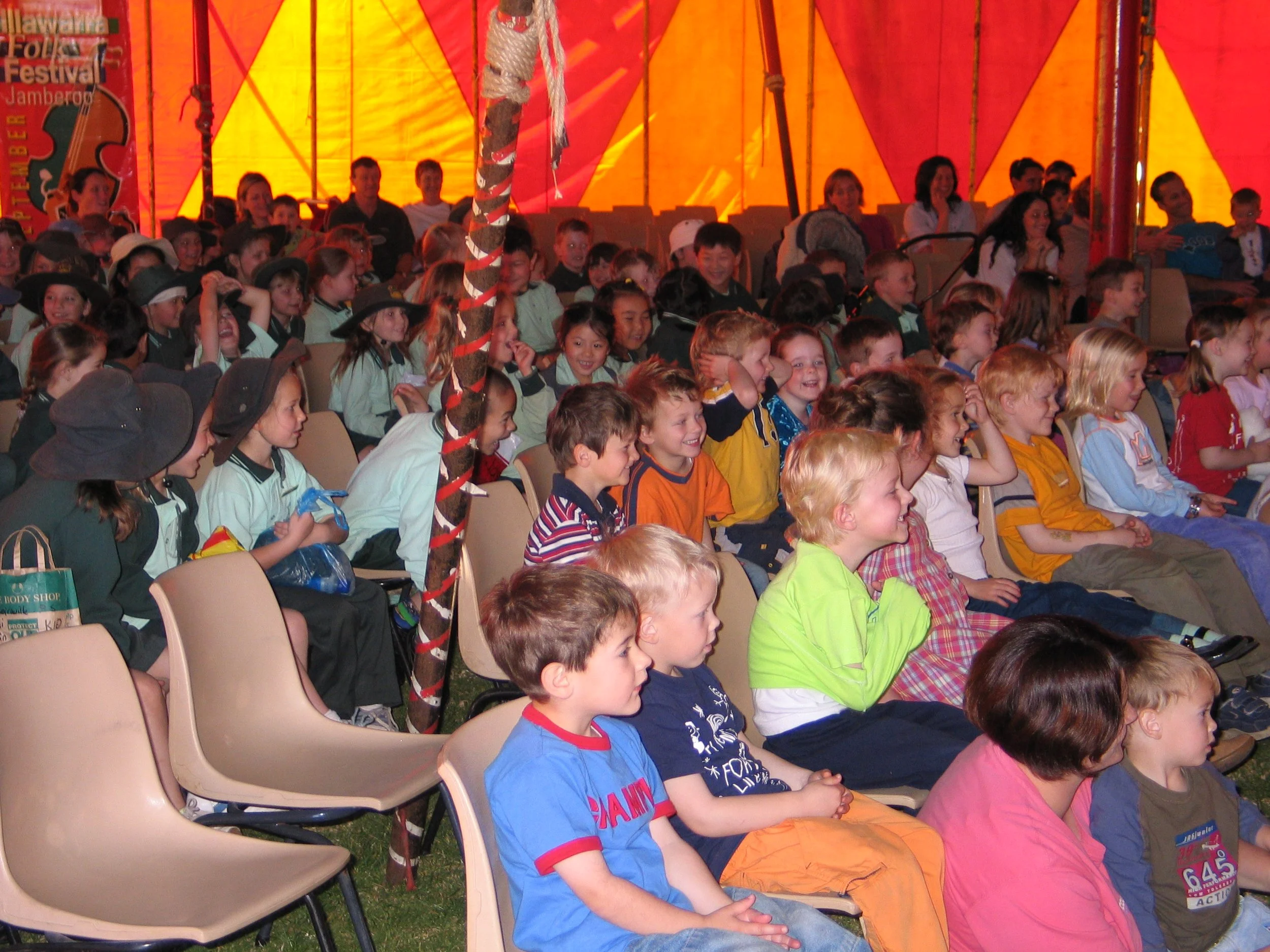
Kids concert in 2003
In his history for the festival's 30th anniversary Russell wrote: “I always remember Geoff Mack, who wrote 'I've been everywhere, man', having the kids clapping in awe at his linguistic convolutions. And then the international acts started to come. The great Tom Paxton and John McCutcheon from US … Faith Petric, The Chippolatas, Frankie Armstrong, Andy Irvine, Geraldine Doyle … and I have vivid memories of Roy Bailey getting a standing ovation after playing to a packed house in the marquee.”
One of David De Santi’s favourite memories from the Jamberoo era was the live ABC radio broadcasts that Illawarra ABC manager Allen Clark arranged for the festival to go live on the Friday night all around NSW. “When Alan left the ABC it didn't happen anymore, which was a bit sad,” Davd said. “The ABC came a few other times (to Jamberoo) because Chris Cartledge was part of the Friends of the ABC. A couple of the afternoon shows came down and did some live crosses.”
ABC Illawarra continues to be a major supporter of the festival, regularly inviting performers into the studio for interviews and performances in the leadup to each year’s festival. Morning Show Presenter Nick Rheinberger is also an accomplished musician who has performed at the festival multiple times.
The festival’s first international commercial performers were an Irish couple Anthony McCartan and Rosie Short, performing as The Churchfitters. They were they were in Australia in 1986 and asked to play. David recalls: “They played at that first one (at Jamberoo), as well as a band from Cairns, Mangrove Jack.”
The festival was growing but it had limited income. The folk club sold weekend tickets but there was an ongoing problem of people being on site without a ticket. Their entry to the tents could be controlled but they could move freely outside and into the popular hotel where entry was free.
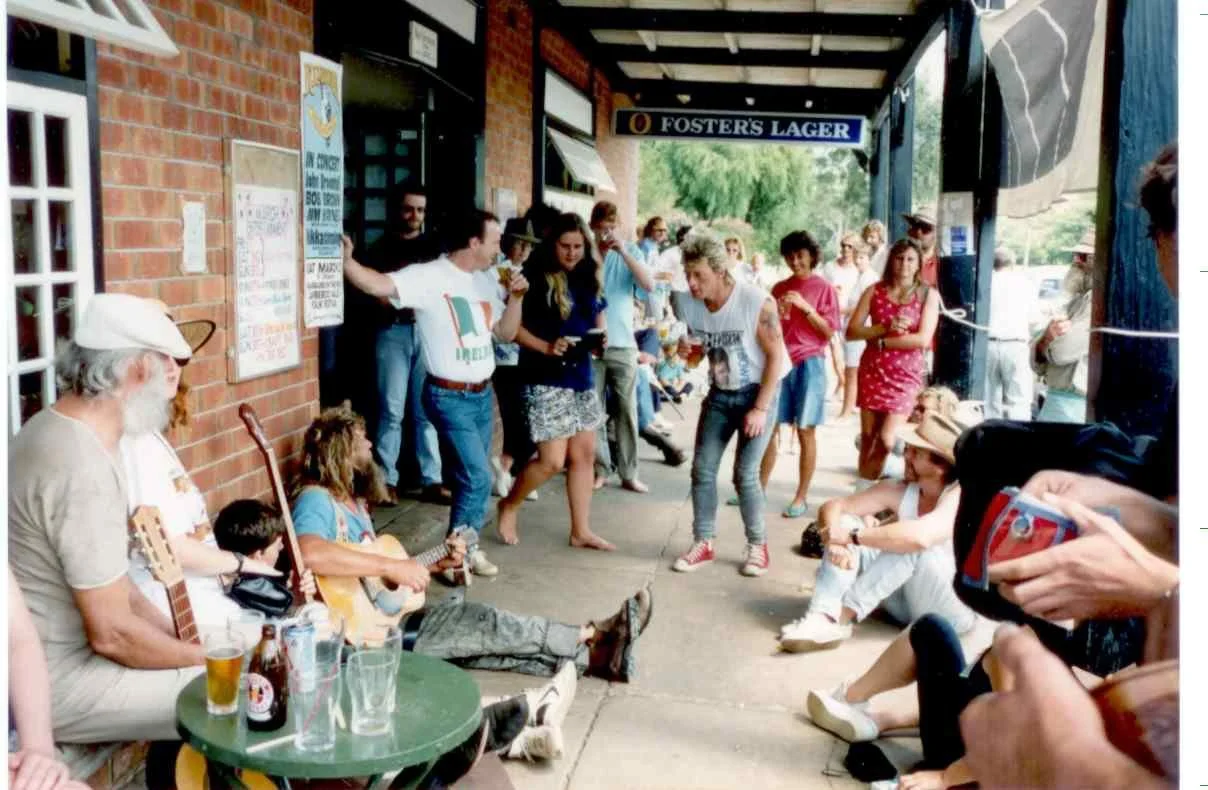
Jamberoo pub 1991
There were some cultural grants for special projects such as exhibitions. Sponsors such as a local bakery would provide wristbands incorporating their logo. There were also more novel ways to raise money, such as the cow pat lotto. Russell explains: “They got a cow in and the paddock was all marked out and people bought spots where the cow might crap. People would sit around and watch where the cow crapped and if they crapped in the square meter that you'd bought, well you won the prize. I can't remember whose idea that was, it was something that the Show Society ran and we said: 'We can do that, we've got the big paddock there next to the town’.”
Handling the cash was another challenge. Russell says: 'Everyone paid cash and we had to store it somewhere, so we used to put it in the safe in the pub. I remember very well myself and Barry Spooner and our treasurer John Baker getting the money out of the safe and counting it sitting in my tent on the Monday morning. There could have been a couple of thousand dollars. We'd put it in piles, wrap it up and take it to the NAB in Kiama.'
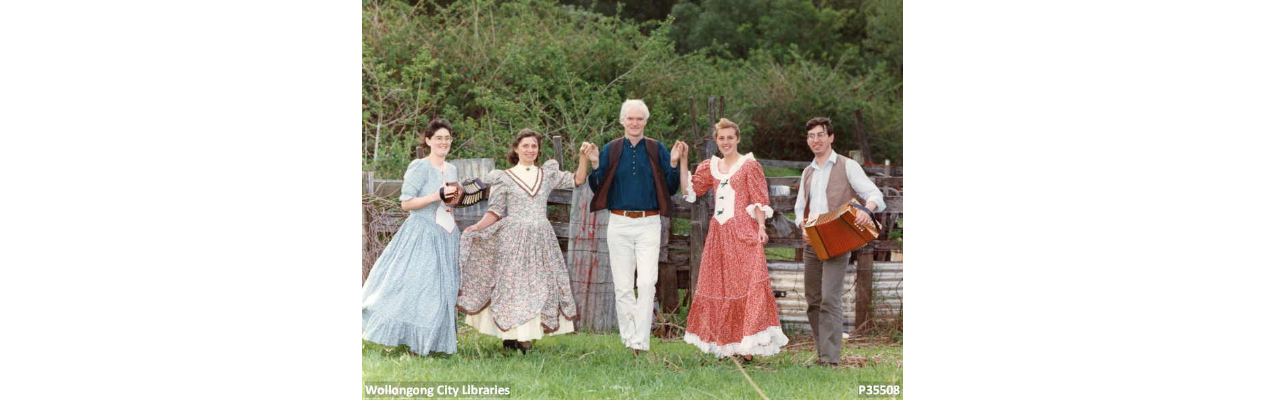
Wongawilli dancers 1993, David De Santi on right
John Hartley stepped down as festival director in 1996 and David De Santi took on the role. The name was changed to Illawarra Folk Festival to cover a possible change of venue. Russell explains: “I had asked the Jamberoo Chamber of Commerce, or whatever it was that ran those things, could we put a sign up at the entrance to Jamberoo that we would pay for that said: Welcome to Jamberoo, home of the Jamberoo Valley Folk Festival, because that's what we called it. And they said no. So, we said, ‘well, we may have to change it sometime, and we are bigger than just Jamberoo, so we will change it to the Illawarra Folk Festival because we are the Illawarra Folk Club’.”
David De Santi worked as an engineer at the Port Kembla Steelworks. “'I was in the civil construction part of the steelworks at the time,” he said. “Being an engineer, you were able to organise lots of things, so I'd try to coordinate and co-opt and encourage people (to get involved with the festival).” He recruited fellow employees and contractors with diverse skills over his long period as director, including Rod Aleckson, Tony Foley (supplies), Tom O'Toole (setup), Neil Rowsell (project management), Greg Adams (first aid), Gary Lebsanft and Mike Burke (safety), Robynne Murphy (waste management) and Robyn Jackson (office).
This array of people with practical skills and contacts proved to be an enormous asset to the festival and reflected Wollongong's industrial legacy.
Selling alcohol provided another income stream. David learned this from Bill Hauritz, long time director of the Woodford Folk Festival in Queensland, who visited the festival in the late ’80s and recommended setting up the festival’s own bar. However, this didn't happen for another 10 years.
Solicitor Graeme Morrison used to attend the early festivals, remembering seeing Peggy Seeger there in the '80s. He grew up in a theatrical and musical family - his father Neil Morrison recited poetry in Stir the Wallaby Stew with Penelope Grace. Graeme became involved in the festival soon after David became director. “In 1998 my wife and I had bought the post office at Albion Park and, of course, Dave De Santi's from Albion Park,” Graeme recalled. “I said: ‘You've got Post Box 17 in Albion Park.’ He asked how I knew that and I said ‘because I've just bought the post office and I've always had an interest in folk music’. And he said: ‘why don't you get involved?’ And I said: ‘Why not?' Graeme initially took photos then became more involved running the festival wine bar.
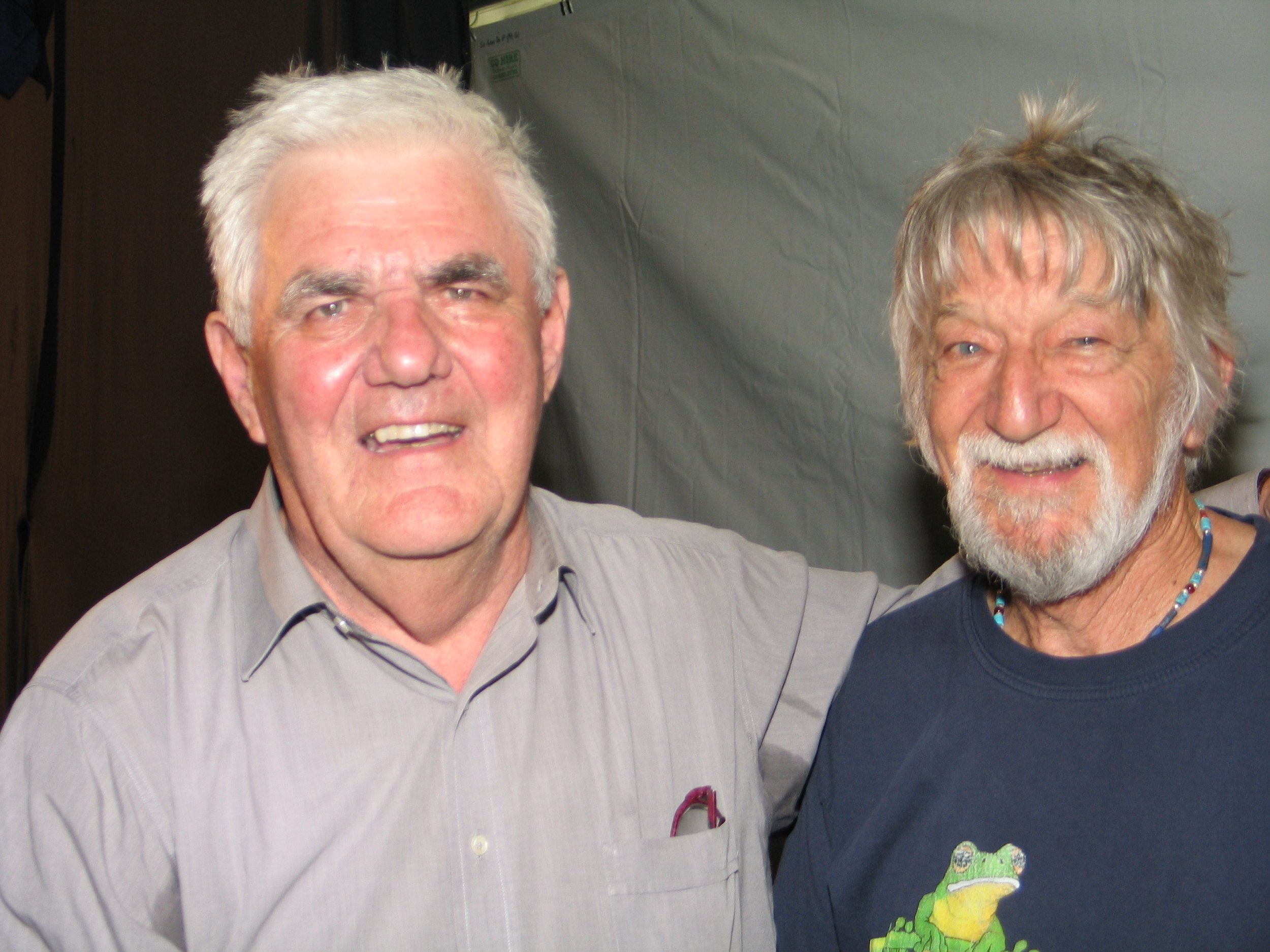
Neil Morrison and Alex Hood in 2004
Graeme recalls the early days of the wine bar: “'My mate Simon Hurford and a few others, Janet Barnes, Peter Butler, Yvonne Butler, Mark Doran, Peter MacLeod, John Chapman, Peter Davies and I took over the running of the bar from the pub in '98. Janet was one of the few prominent women involved in the hard work of the early years. She'd had experience in bars and reluctantly joined this venture. They talked me into it. And I have to admit, I was cursing them, because at Jamberoo we didn't have a lockup. We had like a container, and each day we had to build the bar, and stock the bar, and put it all away at the end,” he said.
“There was a bar in the paddock which was being run by the hotel. And it was a pain in the neck for the hotel because they had to take everything down to the oval and set it up. And you had to pay bar staff and all that.
We approached Ross Warren (the publican) and said: ‘We'll run the wine bar.’ Simon was a licensee of the Oxford Hotel in Wollongong. I was the secretary of the Warilla Barrack Point Surf Club, which had a licence. We were put through a course at the Western Suburbs Leagues Club.
The first wine bar we ran got rid of this wine that some bright spark had bought the year before that was undrinkable. We sold it at a ridiculous price. We also had good wine, which people then bought. We actually made a profit of about $200 the first year. And that's when we got the idea we could take over running of the bar. So '99 was the first year we had a bar run by volunteers from the folk club. It then got bigger and bigger.
“We secured a huge grant from Diageo Guinness, so we sold Guinness products, even though every person at the bar drank Coopers. After three years we could introduce Coopers, who supplied us until 2023. We were one of the first festivals to put Coopers in, and from then on they did major festivals, Woodford and The National and what not, all because of us as we got on very well with the Coopers reps. Besides the money, it was important to have a bar as a social hub and to stop people going off site.”
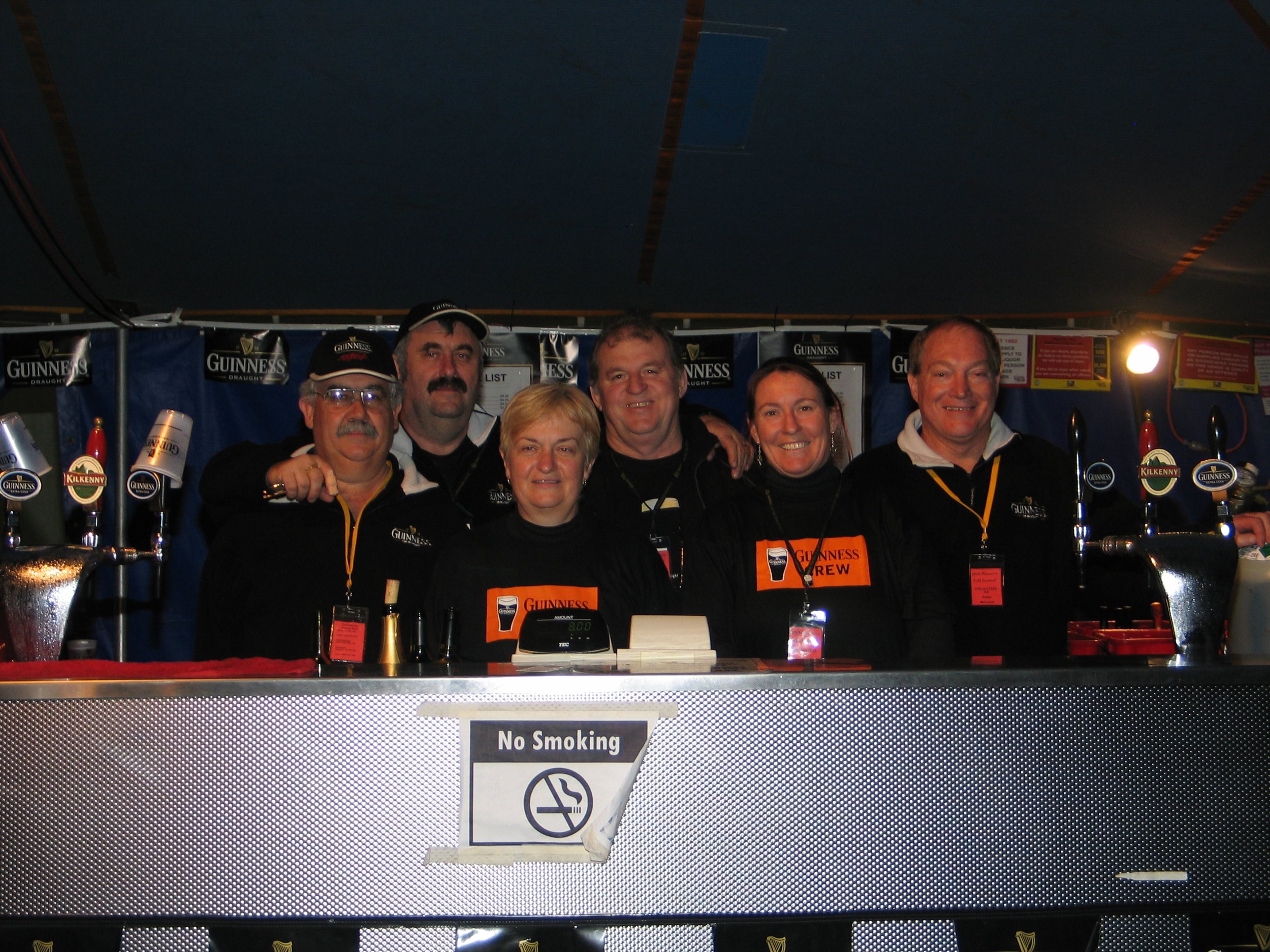
Bar staff 2004, Graeme Morrison back left
Graeme has run the festival bar ever since, providing the festival's second highest income source after tickets. He has been secretary and president of the folk club and is one of the festival's regular photographers.
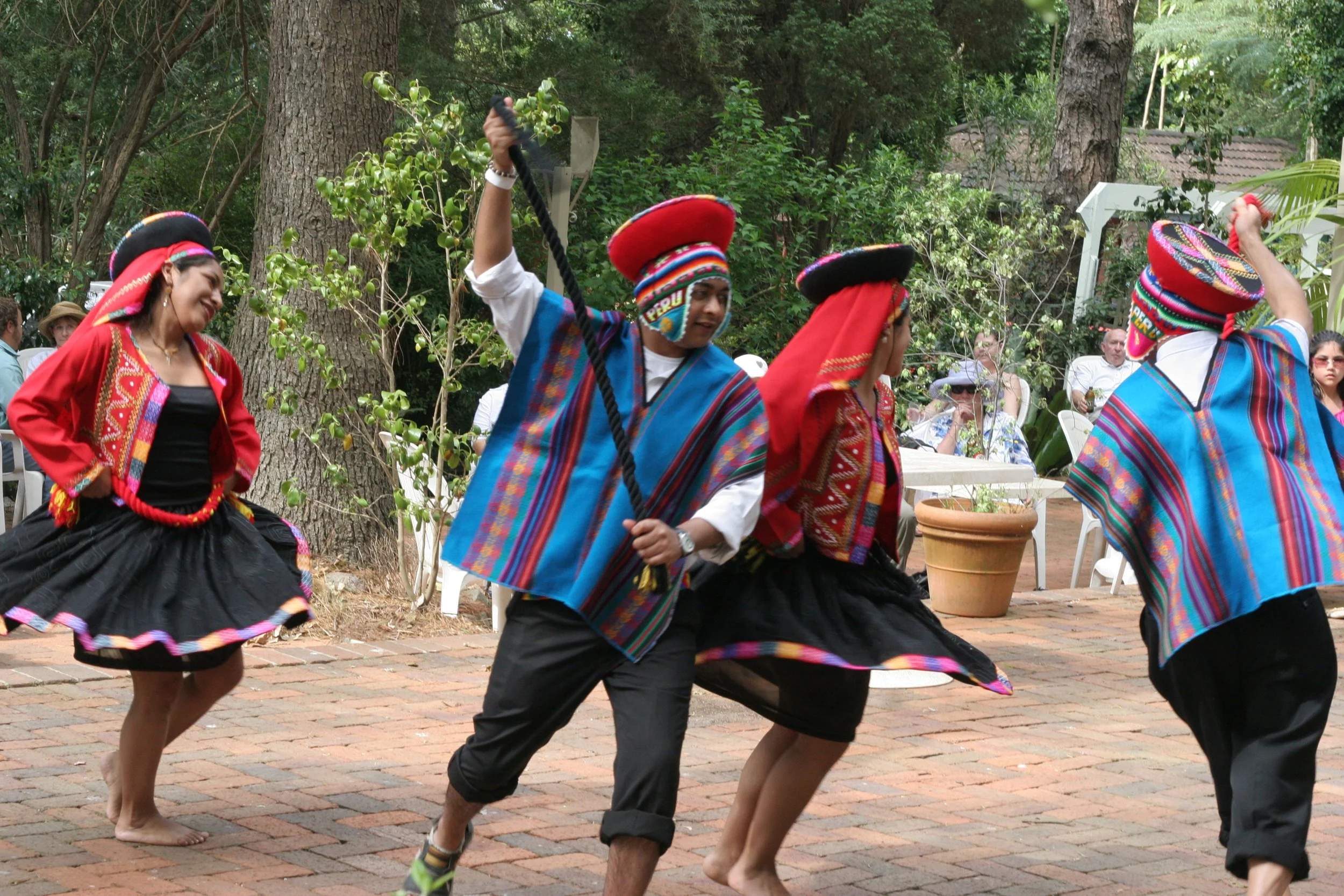
One of David's many legacies was to widen the festival's cultural influences. He says: “In the early days it was very Anglo-Celtic. As I got more involved, I tried to make sure we had a bit more multicultural content. We got the local representatives of different cultural groups involved and I actually was part of that community for a while and tried to encourage those groups to come and perform or dance at the festival.”
This element was later expanded when David came up with the idea for a village green or piazza with food stalls where people could eat, watch performances or dance. He also introduced a successful Italian-inspired food event on a Sunday night and an Italian lunch in the hall. This added to the festival's traditional tripe night, instigated by Russell to indulge a childhood enthusiasm for eating the lining of sheep stomachs.
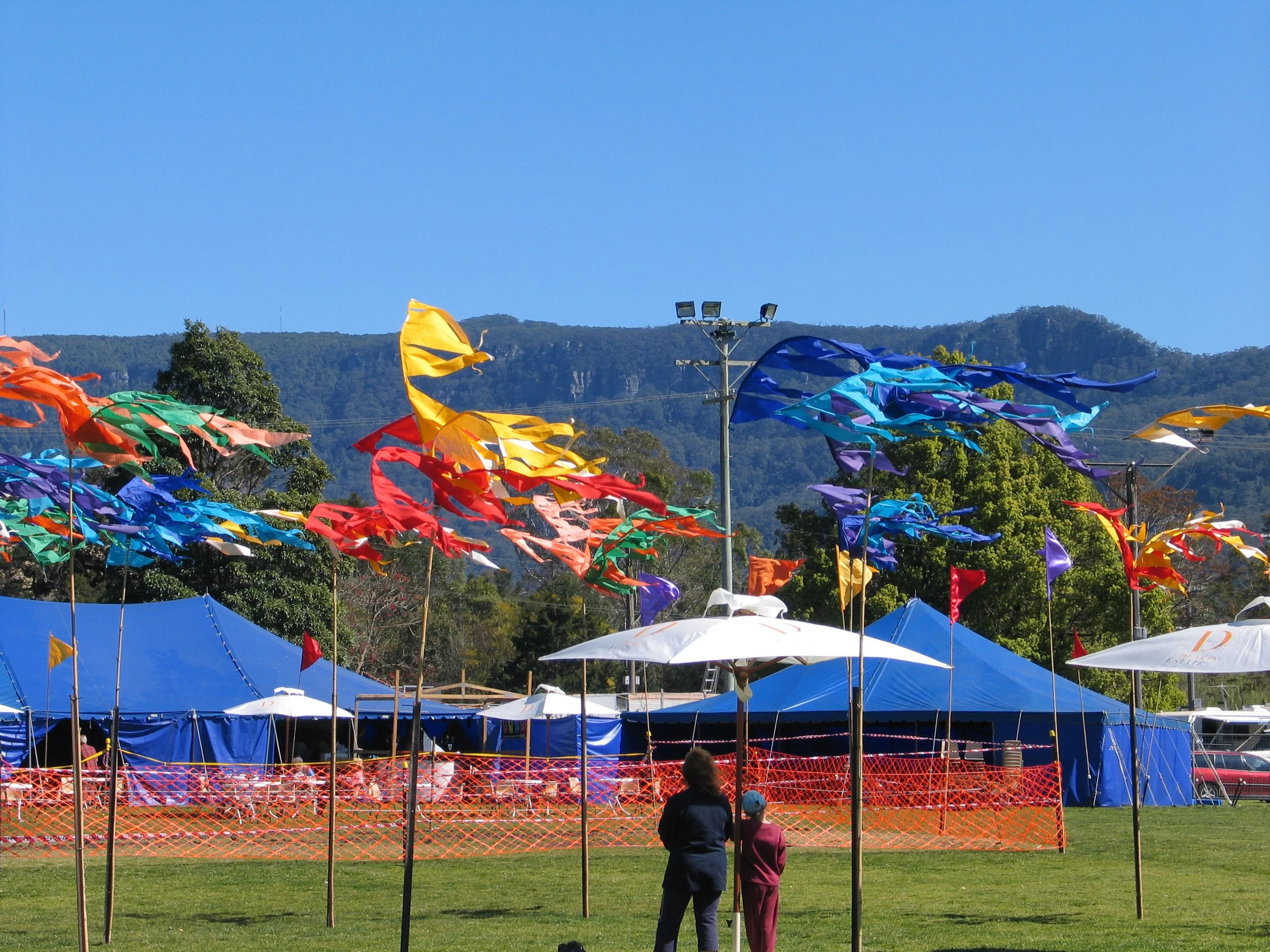
Jamberoo site in 2003
The committee decided to move the festival from March to September, originally in order to capitalise on the Sydney Olympics in 2000. Russell says it was also to placate the sponsor Guinness, who wanted to maximise their exposure by moving it away from St Patrick's Day. But that presented another problem: the seasonal August-September westerly winds that whip through the Jamberoo Valley. “In 2003 we had a big wind and we had to actually stop the festival. Luckily it was a Sunday evening, but it was just too windy and dangerous,” David recalled.
Robyn Jackson was working as a contractor on road design at the steelworks and was put under David's supervision in 2004. “Robyn was telling me she liked dancing and so she would come to the Wongawilli dance which I was presenting and help,” David said. Robyn recalls that one day David was “very worked up” as Chris Cartledge had said he didn't want to continue running the festival office. He asked Robyn if she and her husband Bruce would be interested. Robyn says she didn't see herself as a folkie, but she and Bruce agreed and took over the office, learning on the run and 'bumbling through' with no proper system in place. In those days tickets were A4 vouchers with a carbon copy paid for in cash. Bruce and Robyn have managed ticketing and the office for many years and have acquired formidable institutional knowledge, becoming essential 'go to' people for many tasks.
However, there was trouble ahead. As David explained: “The issue with festivals in towns is that you'll have people that like it and some people don't. It was great for tourism, for people coming to stay, spending money and the public purse would do would do very nicely, shops and venues especially. But some other locals actually didn't like us.”
The organisers decided to put a fence around the site to try to control entry. However, fencing the whole site proved an impossible task so some venues and the camping area remained unfenced, though there were security guards to keep an eye on things. In 2004 there was an uncontrollable invasion. David recalled: “It was back in the day when I guess kids didn't really have that much to do in that area, so they decided they'd target Saturday night at the folk festival. A hundred or more kids turned up in their cars and just started going on a rampage, going through people's tents, taking things, pushing things over and really creating a nuisance. The police were called. I remember I was supposed to get up get up and play with (eight-year-old son) Sam's band that I had created called Big Snore Hammers. I was about to play and then had to go out and confront these kids. It was horrible,” David said.
“Then we had another terrible wind the next night and it was just the end. We thought: ‘This is too hard, what are we doing it for?’ It was quite disappointing because we weren't getting any financial benefit. It was more about bringing some joy to the community and having fun. It was sad to give up the beautiful atmosphere we'd created. And then we basically parked it to try and figure out what to do next. Obviously, we still had the passion to want it to continue.”
It was a tragedy that the now much-loved festival ended in community conflict in its first site. Along with others who worked with him, David's energy, talents and organising skills had contributed enormously to the Illawarra Folk Festival's first 20 years' achievements. These included attracting major folk artists, creating a variety of venues, forging alliances with supporters and contractors, running a bar, increasing the multicultural content and fostering a volunteer community to manage the challenges of an increasingly complex event.
Bulli 2006 to present
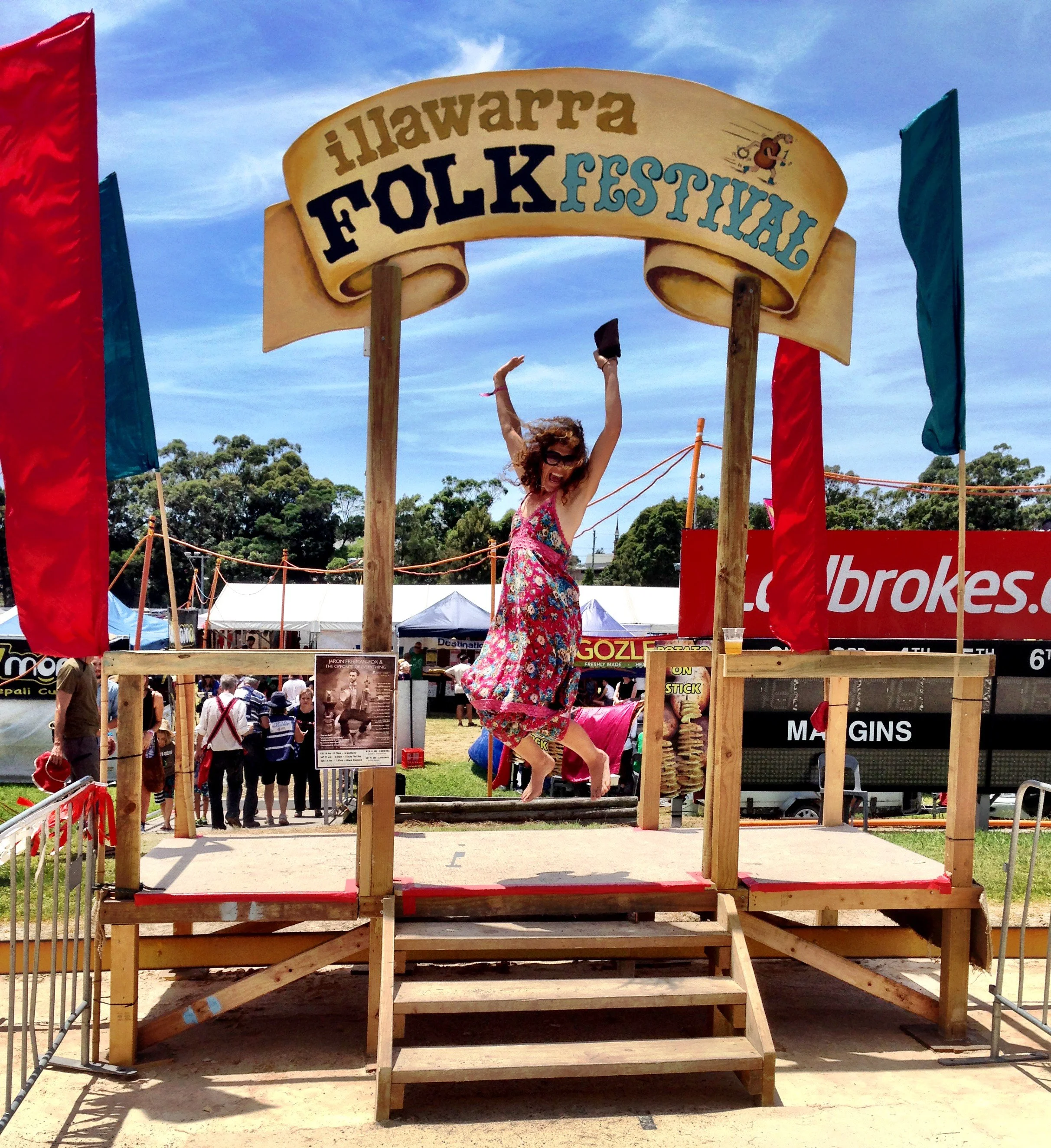
After extended efforts to find another site the folk club made the decision to hold the festival at Bulli Showground. Situated at the base of the Bulli Pass, it consisted of a large oval and a number of buildings in various states of repair, with the electrical system in particular the cause of many headaches. The site was developed in the 1940s as a sporting ground, later expanding to become a venue for agricultural shows from 1953 until 2018. The first greyhound race there was in 1950 and the NSW Greyhound Breeders, Owners and Trainers Association (GBOTA) still manage the site.
The main grandstand building had a large, covered betting ring that could be converted to several venues, a bar and a shop. In the early years a large tin shed that housed the agricultural pavilion during show times and even the old harness racing stables were used as performances spaces. However, other venues had to be erected and decorated, dance floors constructed, camping and stalls areas planned and traffic routes marked out. David says that despite the lack of undercover spaces, “the good thing was that there was a lot of grassy areas that gave us challenges to see how we could use them”' Situated west of the showground was the Grevillea Park featuring many species of grevillea amidst escarpment bushland. A marquee in the bush setting at the top of the park made a particularly appealing venue.
DaPeter Butler and Graeme Morrison first suggested Bulli Showground as a possible venue. David's first reaction at the time was: “We're going to a dog track? How does that work? But Peter and Graeme saw the vision of the space and the big advantage of course is that it had just one gate.” The inability to control people entering the festival at Jamberoo led to its demise there, so this promised a new secure beginning. The first festival at Bulli was on the Australia Day weekend in January 2006 with 11 venues. Some traditions were carried over: the opening charity concert and tripe dinner, Italian lunch, union choirs, poets breakfast, festival orchestra and choir.
The core volunteer leaders came too, including Russell, David, Graeme, Bruce and Robyn, Ann Lehmann and Tony Foley, all of whom are still involved. Ann's role was managing the program for young people and the folk school. Tony is a behind the scenes person who was crucial to logistics at Jamberoo, particularly the fencing efforts. At Bulli he quietly checks all the supplies, replenishes or acquires what we need and keeps things stored so he can always put his hands on what anyone needs.
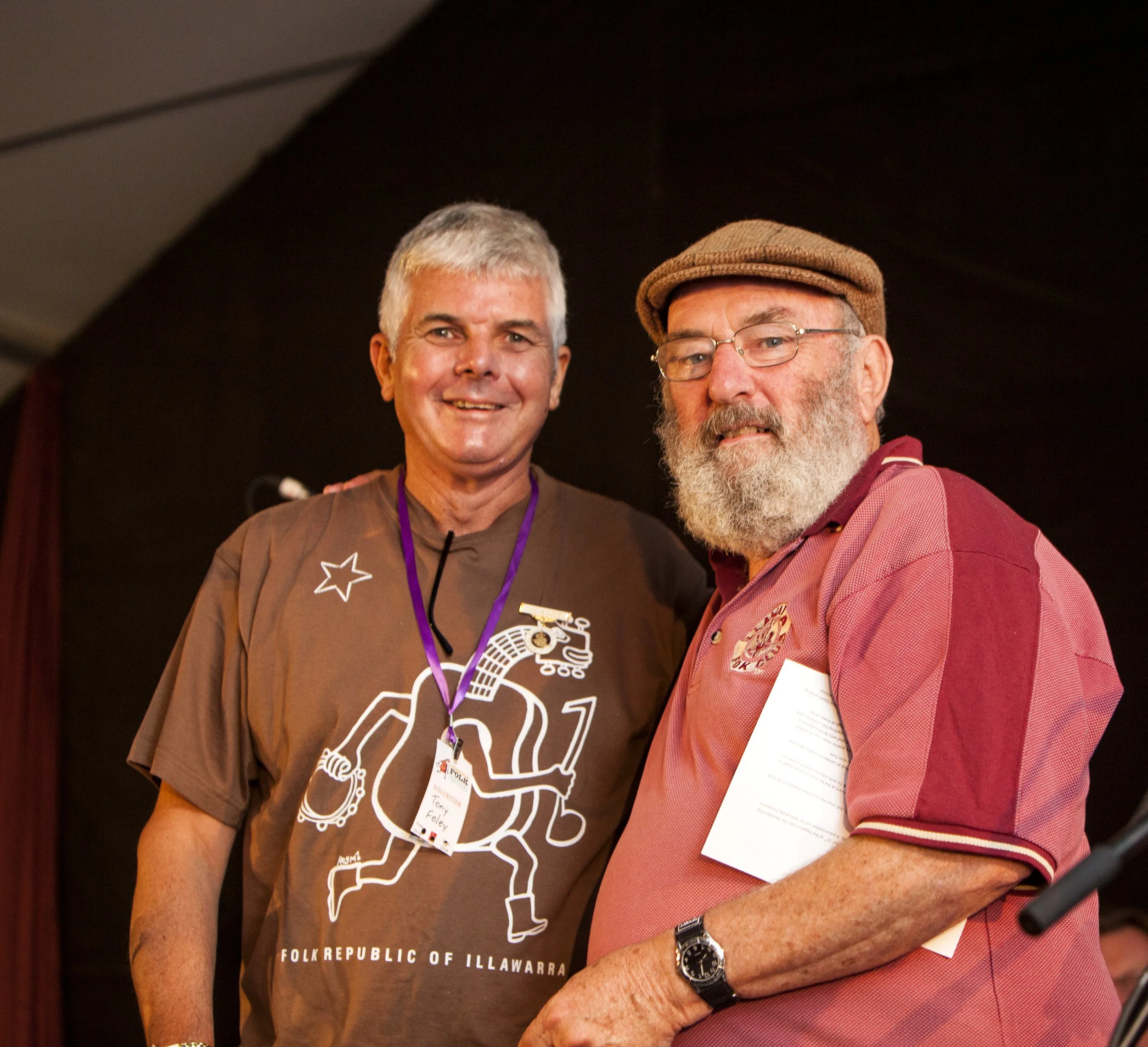
Tony Foley and Russell Hannah in 2013
But the folk club was keen to recruit some northern suburbs locals to help. Ross Dearden explains: “I got involved because Margaret and I had been key people in organising the picket (an anti-development protest at Sandon Point), and we had a large network of friends and contacts in the Bulli area. I knew Bruce Jackson from work (he was a surveyor) and it was mainly through him and Robyn it got around to me that because they were moving up from Jamberoo to Bulli, they wanted to have local contacts so that they could get volunteers and community partners.”
I was among this group of Northern Suburbs residents who that joined in the early years. The recruits included Suzi Wakefield, who continues to do a lot of community liaison, arranges billeting and runs the volunteer kitchen, Lana Patrin who decorated the stages for many years, Judy Bourke, who has done many jobs including managing camping with Ross, Angela Cook, who took over managing signage from me and also runs the raffle, and Ann Proudlove who registered performers. Many others were to join the committee and take on major jobs.
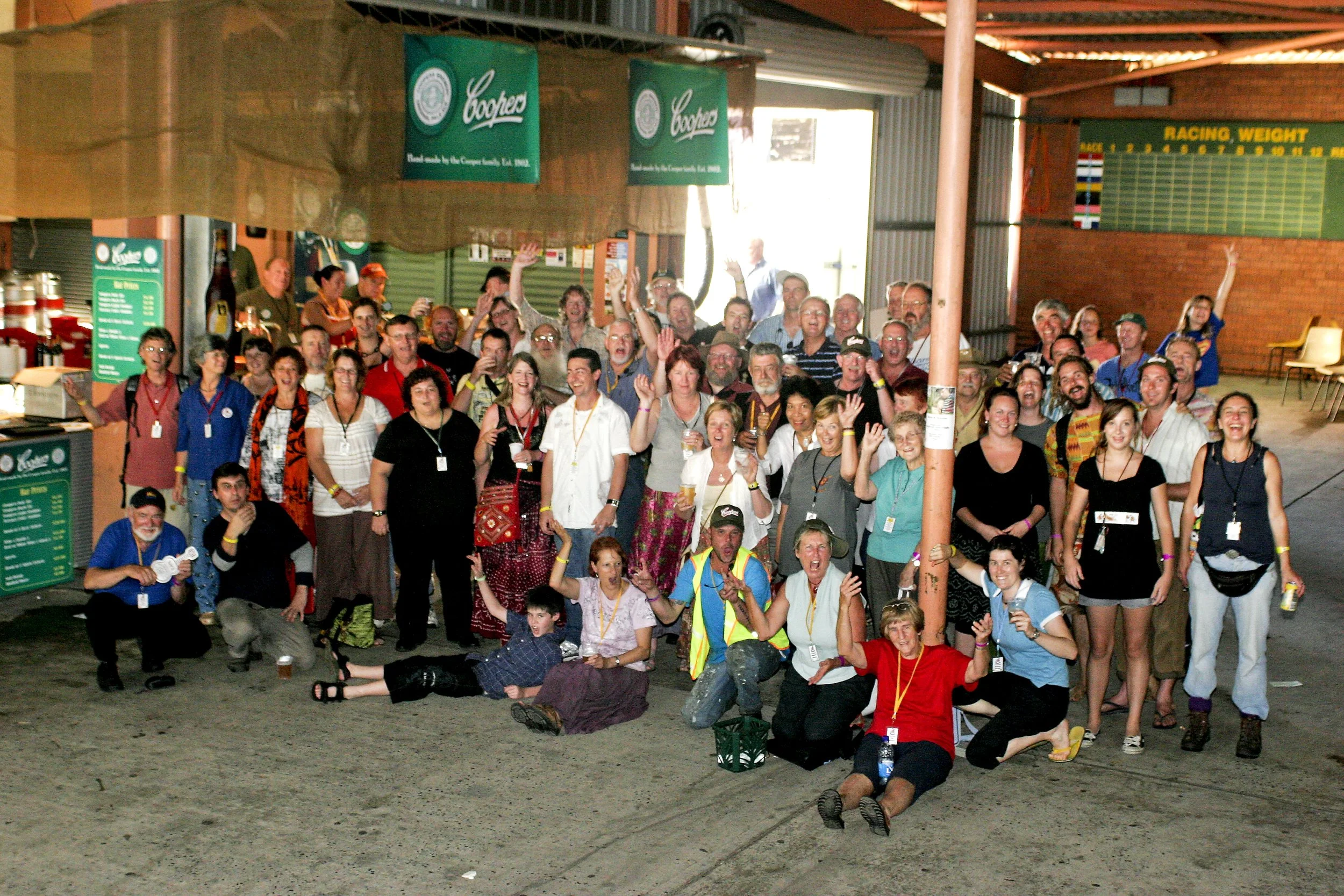
Volunteers 2008
Nick Hartgerink, former editor of the Illawarra Mercury from 1995-2001, and I shared a motivation for getting involved: we both had children aspiring to perform. Nick said: “I had helped the festival with publicity when I was at the newspaper but got directly involved after my daughter had applied to play there. I thought, well, if they're going to give her a spot, then I should get more closely involved. And so I joined (in 2009).” Nick’s daughter Penny Hartgerink played at many festivals, solo and with others. My high school son Jim tried to introduce reggae to the festival in 2006 and finally returned to play with Sub-tribe last year.
“Therese Gregory was doing the publicity, and she said, ‘Well, since you're a journalist, you can have that job’. Which was fair enough, and so I took on the publicity officer's role from Therese, and I've been doing it ever since,” Nick said.
Shane Moon, later to become the festival's first woman director, says: “I started first performing with one of the belly dance troupes a very, very, very long time ago. And from there, I just really loved it. I loved being involved in it. And what a great way to be a part of a festival than to volunteer for it. I started volunteering and landed pretty early in the role of merchandise team leader, selling festival and artist merchandise. And I did that for about 15 years.”
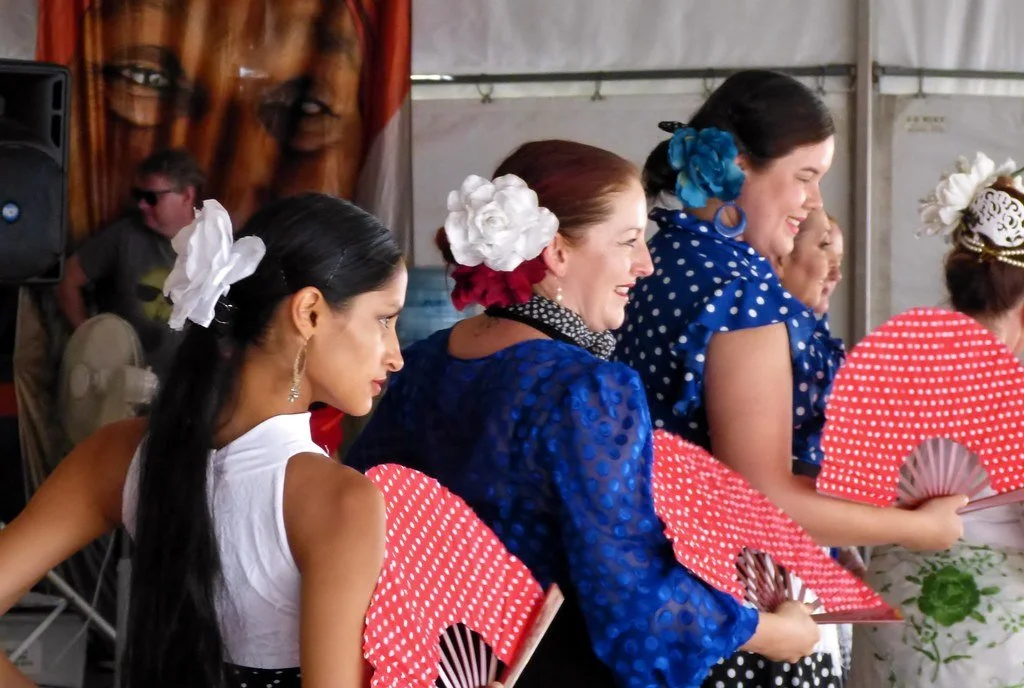
Shane (centre) dances with flamenco group Ruido 2014
The Australia Day weekend date proved to involve too many clashes, so the festival moved to the preceding weekend and has been on that third weekend in January ever since - except for the COVID years of 2021/2.
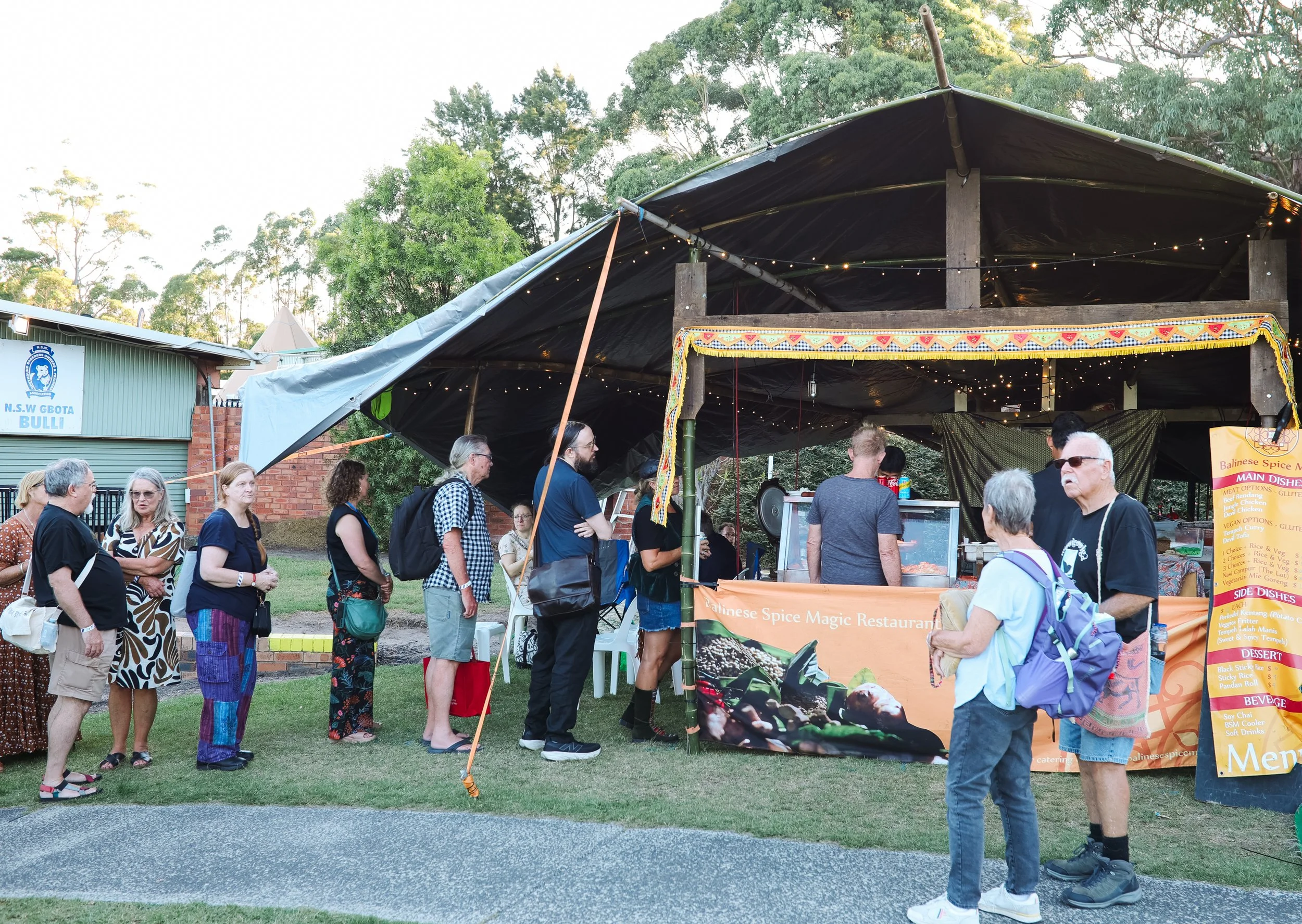
Initially there was some suspicion and tension in the relationship with the greyhound community - a clash of cultures, and time clashes when the festival and Friday night dog races were held simultaneously. The races were scheduled for broadcast and so out of the local club's control. In the early years the festival was interrupted to accommodate immovable races. Festivalgoer Maree Miller recalled: “Our first year (at the festival), we were looking at camping, and the greyhounds were still running. And there were people down in the grandstand betting and we couldn’t camp on the oval. It was like, oh wow, okay. And then on the Friday night the greyhounds raced and it was like oh, in between this festival. So that was very interesting, very different to what you expect at a festival.” Later, better relations meant greater co-operation and such clashes were avoided.
At first the festival spread beyond the showground precinct to include the Heritage Hotel on the Princes Hwy at Bulli and the nearby Bulli Bowling Club (for one year), based on the model that had worked at Jamberoo. But this was not to last, with the Heritage pulling out in 2009. Though this had been a ready-made and atmospheric venue, Graeme Morrison notes that its loss benefited the bottom line as there was now only one entrance and one source of alcohol, which “stops people from wandering away”.
Bulli railway station is close to the showground, so people could come by train, particularly from Sydney. The festival took advantage of this by introducing a music train. Brian Dunnett instigated this and ran it for several years from 2009 until he died in 2016. There would be two designated trains on Saturday morning and one on Sunday morning with festival artists performing in two different themed carriages on each, at first all the way from Sydney Central, but later just from Waterfall.
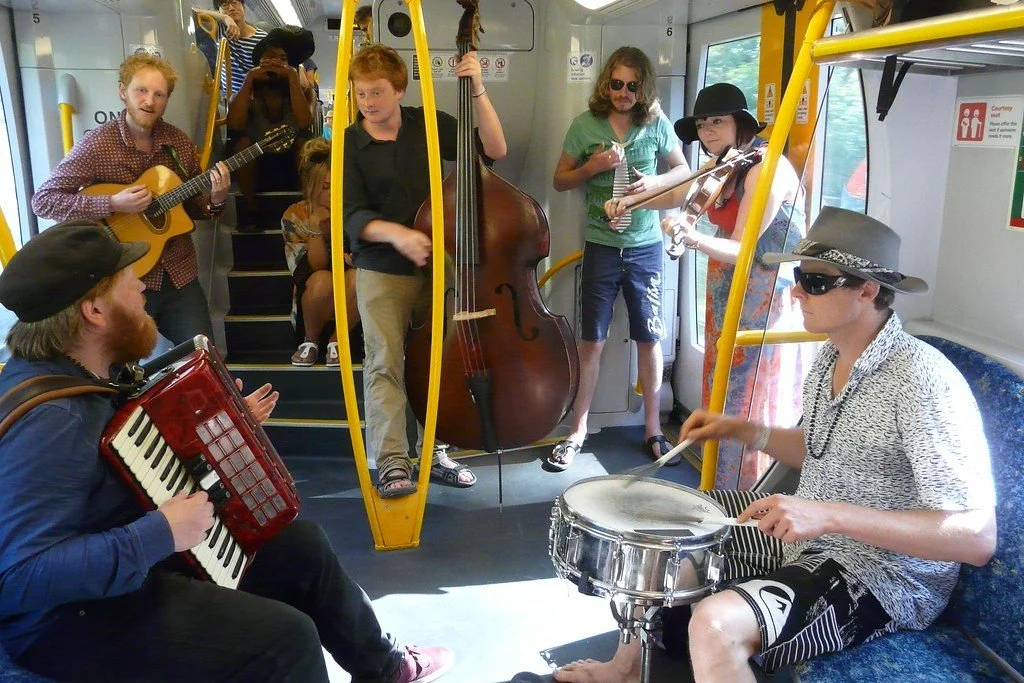
Music Train 2015
In 2008 shift managers were introduced to establish a line of responsibility for dealing with operational issues and take some of the load off David De Santi. In 2009 Rod Cork became traffic manager, a demanding and exhausting role. He and wife Judy lived in Sydney but had attended a number of our festivals and planned to move to the area (eventually settling in Kiama). They became festival mainstays, doing key work in setup, site management, stores and liaison with Wollongong Council, who required detailed site management plans.
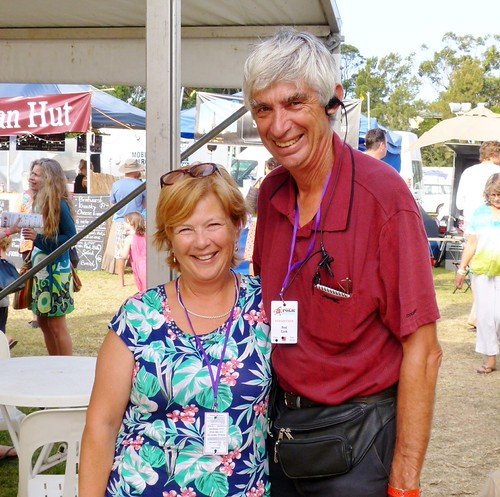
Judy and Rod Cork 2014
Rod passed away in 2022, but Judy explained his contribution: “At that time there was a lot more bureaucracy and a lot more things that had to be sorted out, like compliance … like the stalls all had to have all their leads tagged, and we had to have engineering certificates for all the stages. Rod was very good at finding out rules and making sure everyone obeyed them. The emphasis on compliance put a totally different emphasis on running it.” This approach could be a challenge for people used to their own ways, but Rod became an indispensable problem-solver and it was a great loss for the festival when he passed away in 2022.
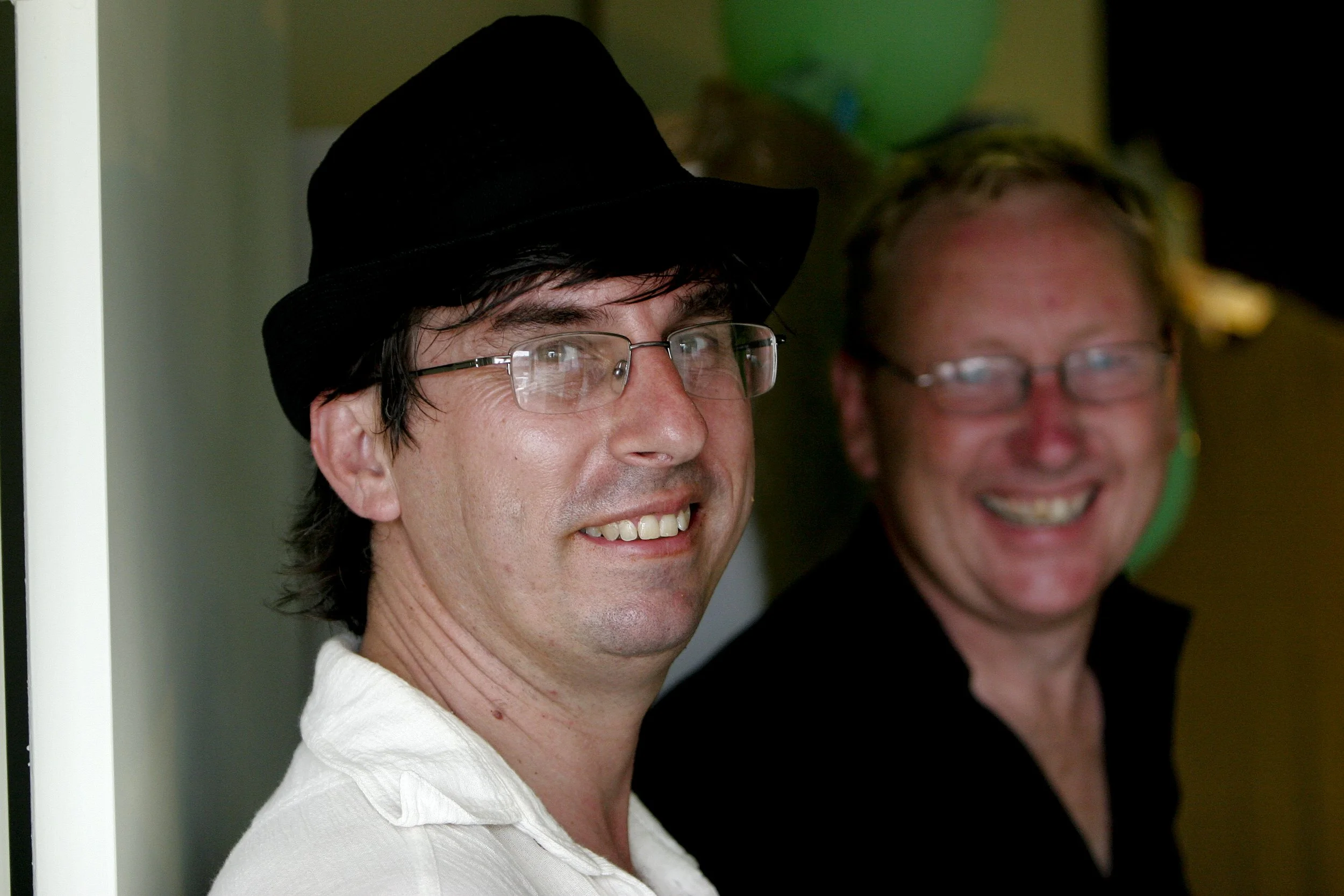
David De Santi And Mark Holder - Keeping 2009
Gradually David De Santi worked to step back from being “the crazy guy trying to manage everything”. For the 2010 festival he announced that he would keep the role of artistic director, but hand over many other organising roles to the committee and a number of new people stepping up. Neil Rowsell became project manager, taking over many of David's roles including managing on site operations during the festival. Rod became set up manager, doing the liaison with Council and ordering the major services such as venue tents. The number of volunteer roles continued to grow. The 2010 festival contained an Instrument Lockup for the first time, led by Sue Bromham who came with experience at the National Folk Festival. There was a designated safety officer from 2012.
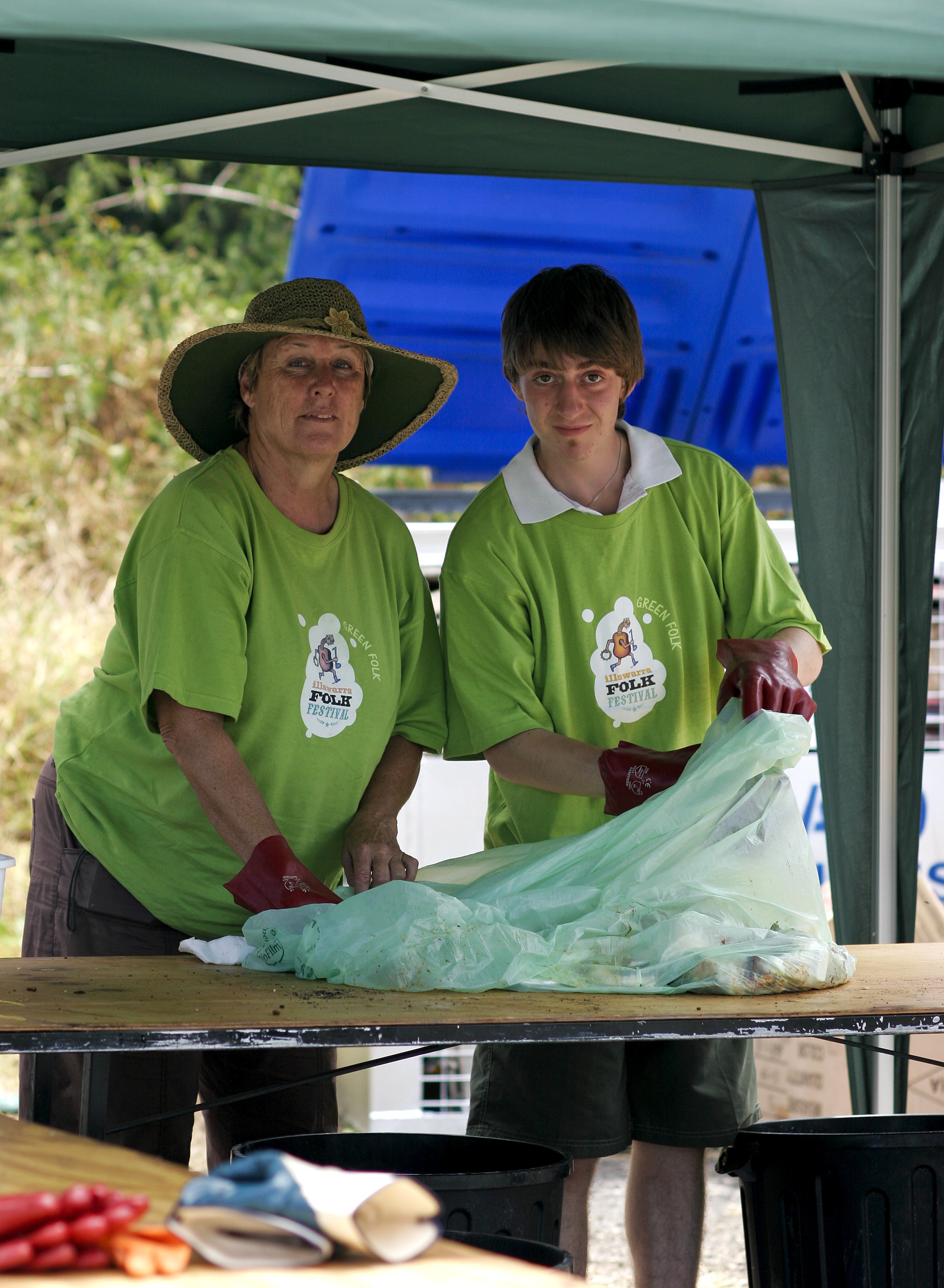
Robynne Murphy and recycling helper 2009
It was always a big undertaking to sort and manage waste and over many years sincere attempts were made to eliminate waste going to landfill. These efforts were led by Robynne Murphy, who David says was “super passionate about recycling and green outcomes, but it meant there was a lot of work to make that happen”. Despite the festival's commitment to sustainability, it was very difficult to police what people put in the bins. When the refugee support organisation SCARF, later through Green Connect, provided a team to monitor the bins in 2012/13 the recycling rate reached new highs.
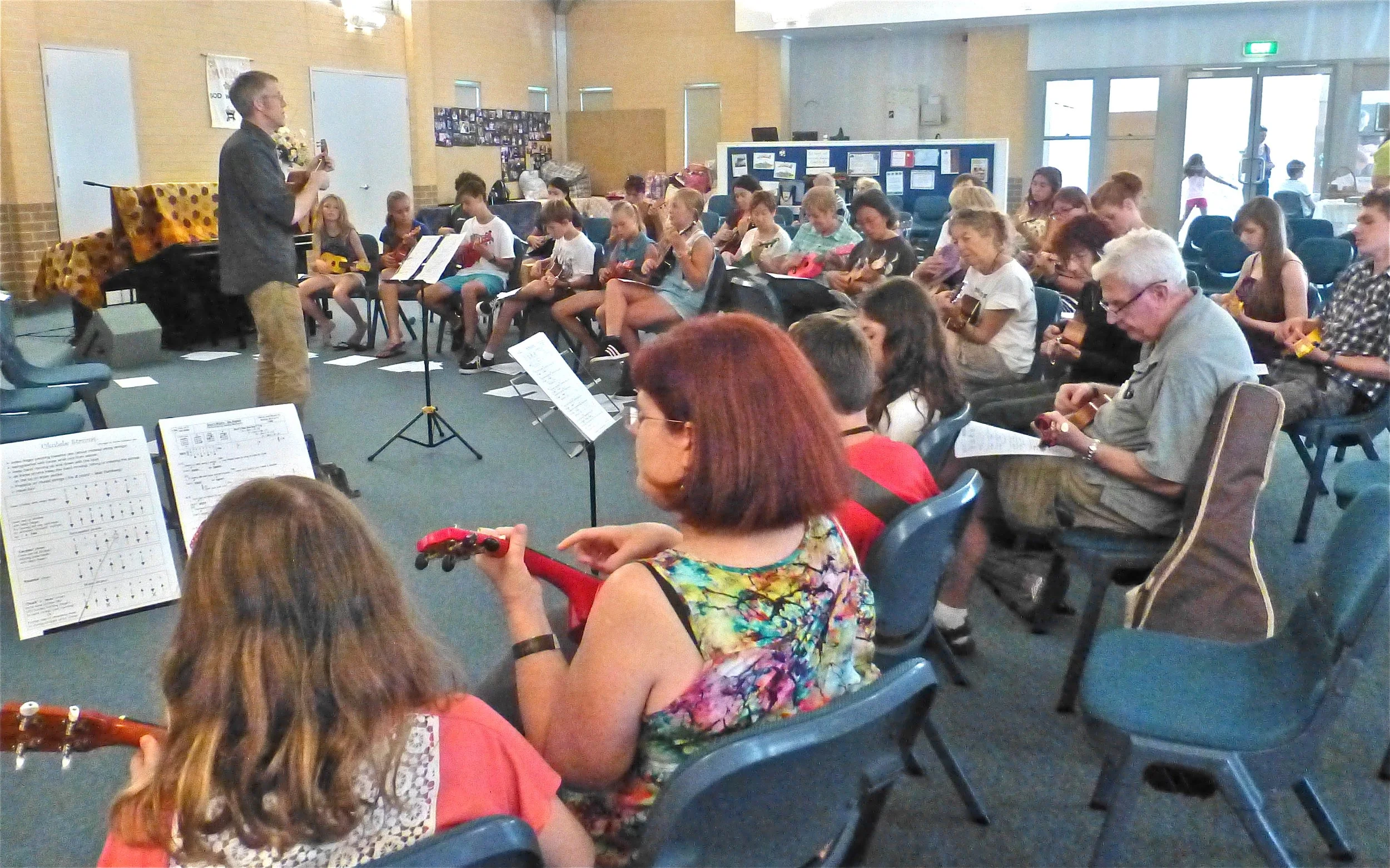
Folk School session with Bertie McMahon 2015
There were week long instrumental intensive workshops at Jamberoo, but when Ann Lehmann revived the idea at Bulli in 2008 as the fifth Illawarra Folk Summer School, she took a more ‘taster’ approach for people of all abilities. The folk school took place for two days before the festival and featured festival artists as tutors. In 2020 Ann explained: “We have from 9 to 5 each day three simultaneous sessions where people can do hour-long workshops in things like song writing, singing, guitar, banjo, Italian mandolin and this year the uilleann pipes, which is the Irish pipes. All these amazing folk traditions are quite niche and people get a chance to learn with our international guests at the folk festival but also national and local guests as well.”
Although she has moved to Tasmania, Ann continues in this role with the help of Shalani Thomas, though the folk school has been reduced to one day.
As the festival continued to grow and incorporate new elements, regular performers such as Alan Musgrove, Bob McInnes, Wongawilli, Chloe and Jason Roweth, John Dengate, Bob and Margaret Fagan and John Broomhall continued to feature, but each year there were more artists from abroad and from around the country.
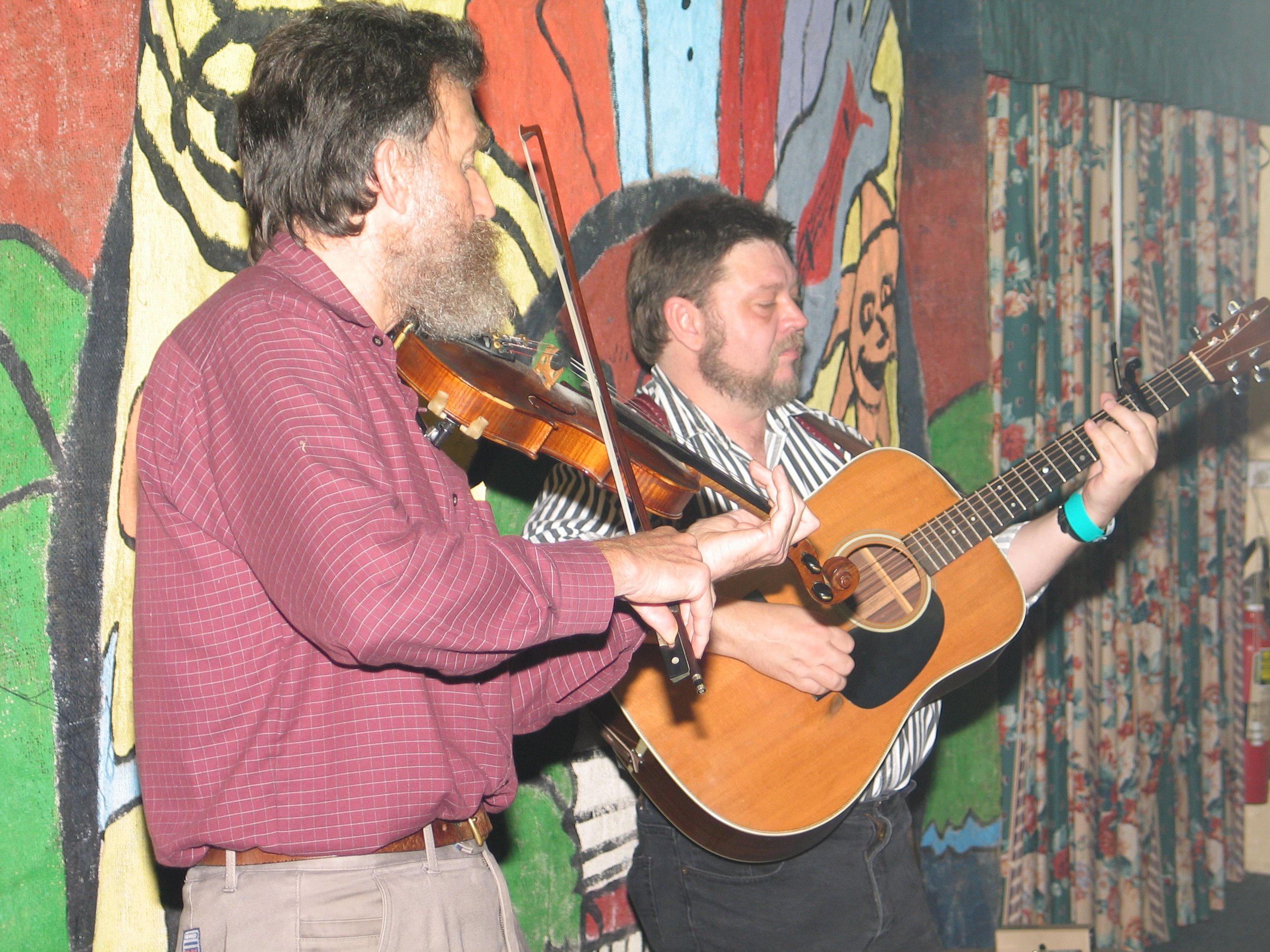
Bob McInnes and Alan Musgrove 2007
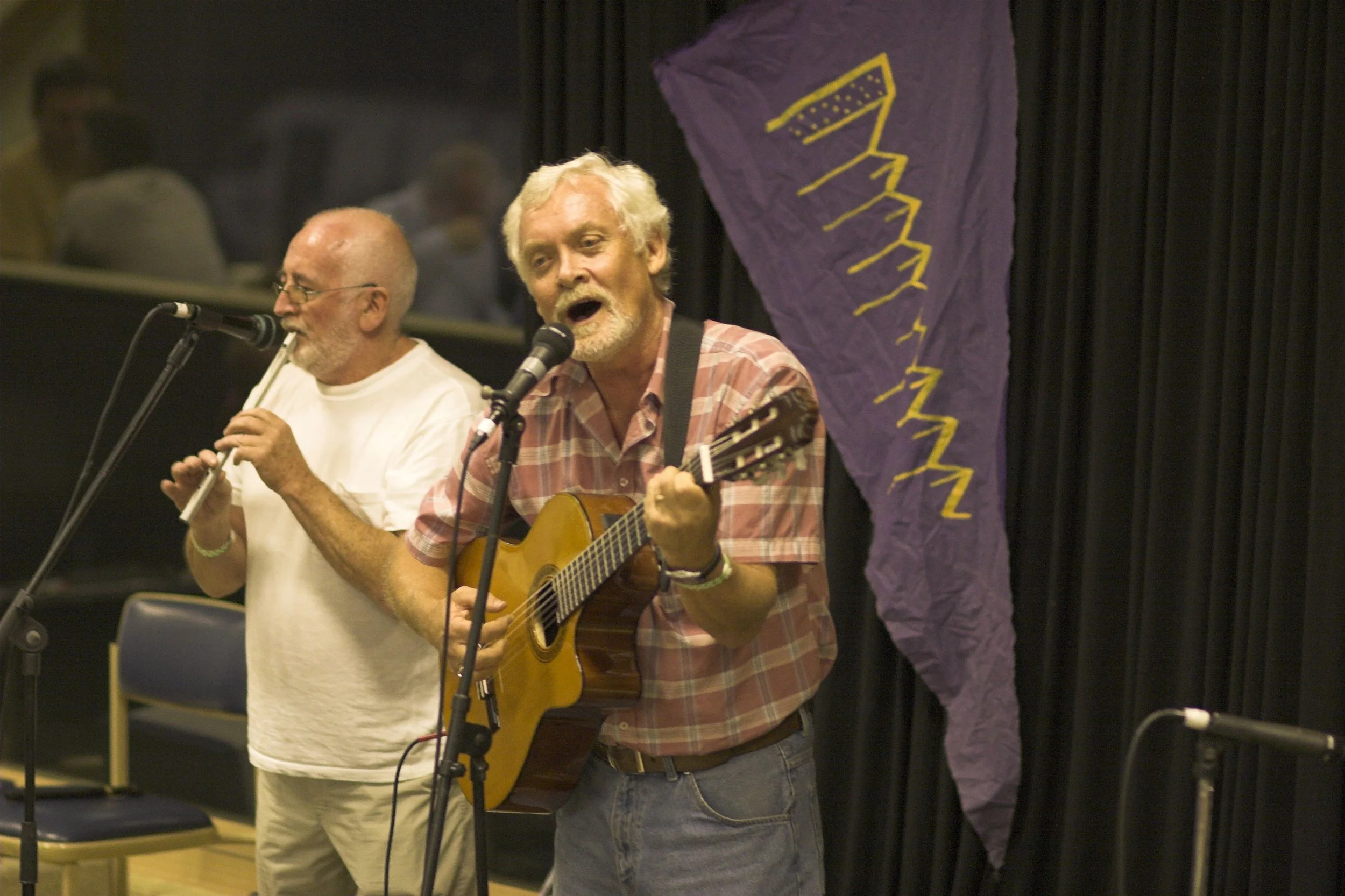
Johnny Spillane and John Broomhall 2007
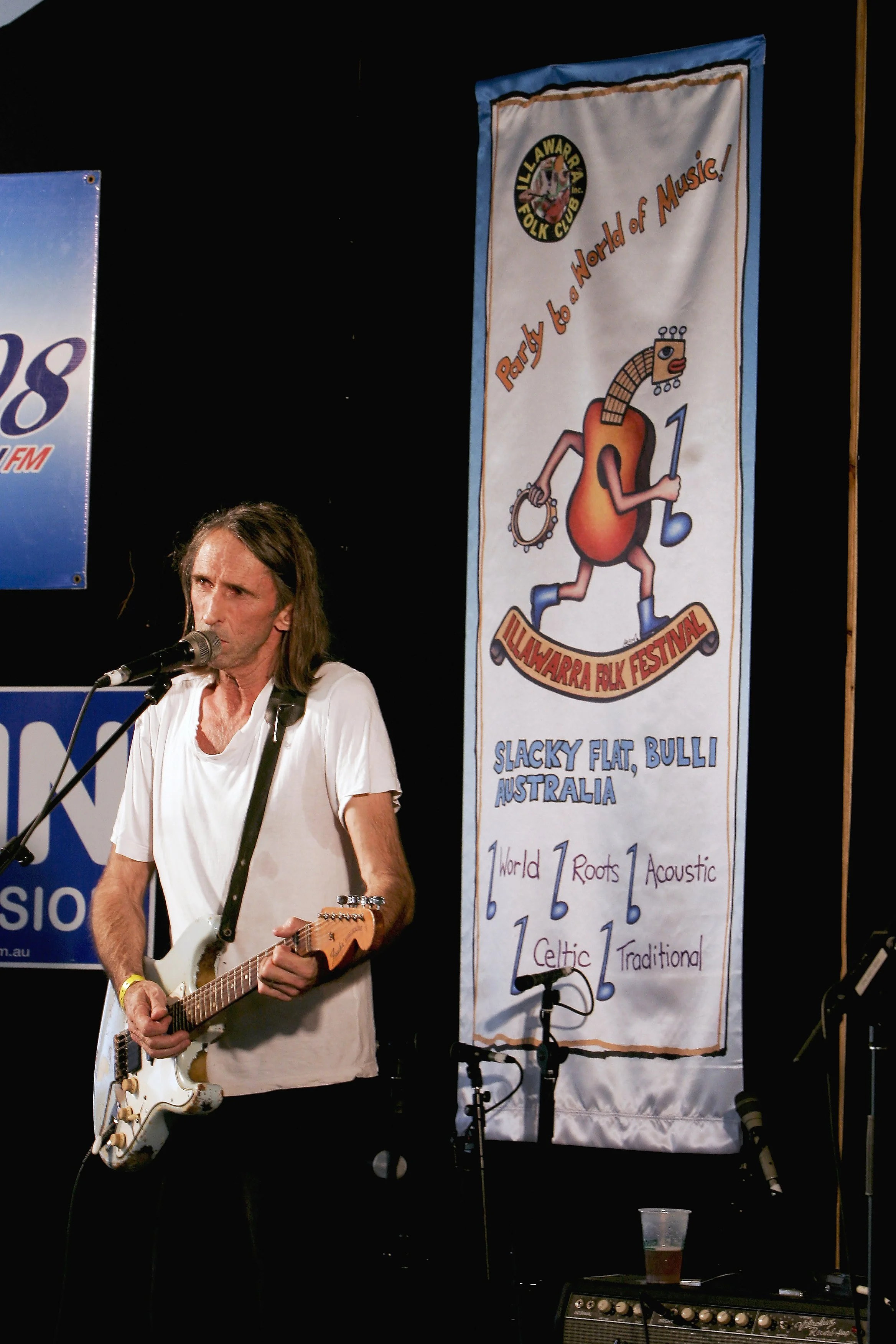
Dog Trumpet with Riff sign 2008
Many overseas musicians have come to the Illawarra Folk Festival as part of an Australian tour, after they had performed at the Woodford Folk Festival in Queensland at the end of December. These have included the Canadian The East Pointers, Irish Mythen and Grace Petrie, Rory McLeod and Dougie McLean from the UK and Peggy Seeger from the US. The Aboriginal legends Archie Roach and Frank Yamma have performed many times, while popular artists have played solo or in small groups, such as Christine Anu, Jeannie Lewis, Neil Murray, Shane Howard, Jim Mogini and David Bridie. When Reg Mombassa performed in the duo Dog Trumpet in 2008, he contributed the walking guitar figure Riff, which is still the festival's icon.
In 2012, a theme instrument feature was introduced. That year it was the autoharp as a number of autoharp players from the US attended. The theme instrument continued until 2019.

Accordion was the theme instrument in 2013
Gail Norris is an American who lives in Hawai'i. She discovered the Illawarra Folk Festival one year while visiting her daughter in Sydney, and has subsequently arranged her visits to volunteer ever since. She said in 2020 that she loved both international and local components: “Our international stars are wonderful, they bring people in, and I love seeing people I would never have a chance to see or people that I have seen somewhere else in the world, like Dougie Maclean. I have seen him in Cape Breton and in Scotland and in the US and I’ve seen him here. That’s great. But I also love seeing (Kiama band) The Water Runners, and I love watching (young singer) Shalani (Thomas) grow up to be a lovely musician. It’s just fine.”
David De Santi and his son Sam joined the Con Artists, a community band at the Wollongong Conservatorium of Music run by David Rooney - a large, exuberant group playing many brass instruments. The Con Artists performed for many years at the folk festival beginning in 2011 and the collaboration between the two Davids was to influence its character. David Rooney also ran the festival orchestra, and his partner Lotte Latukefu ran the festival choir, both of which would perform together with guest soloists in the festival finale. But the 35 per cent increase in attendance in 2011 created new challenges of scale.
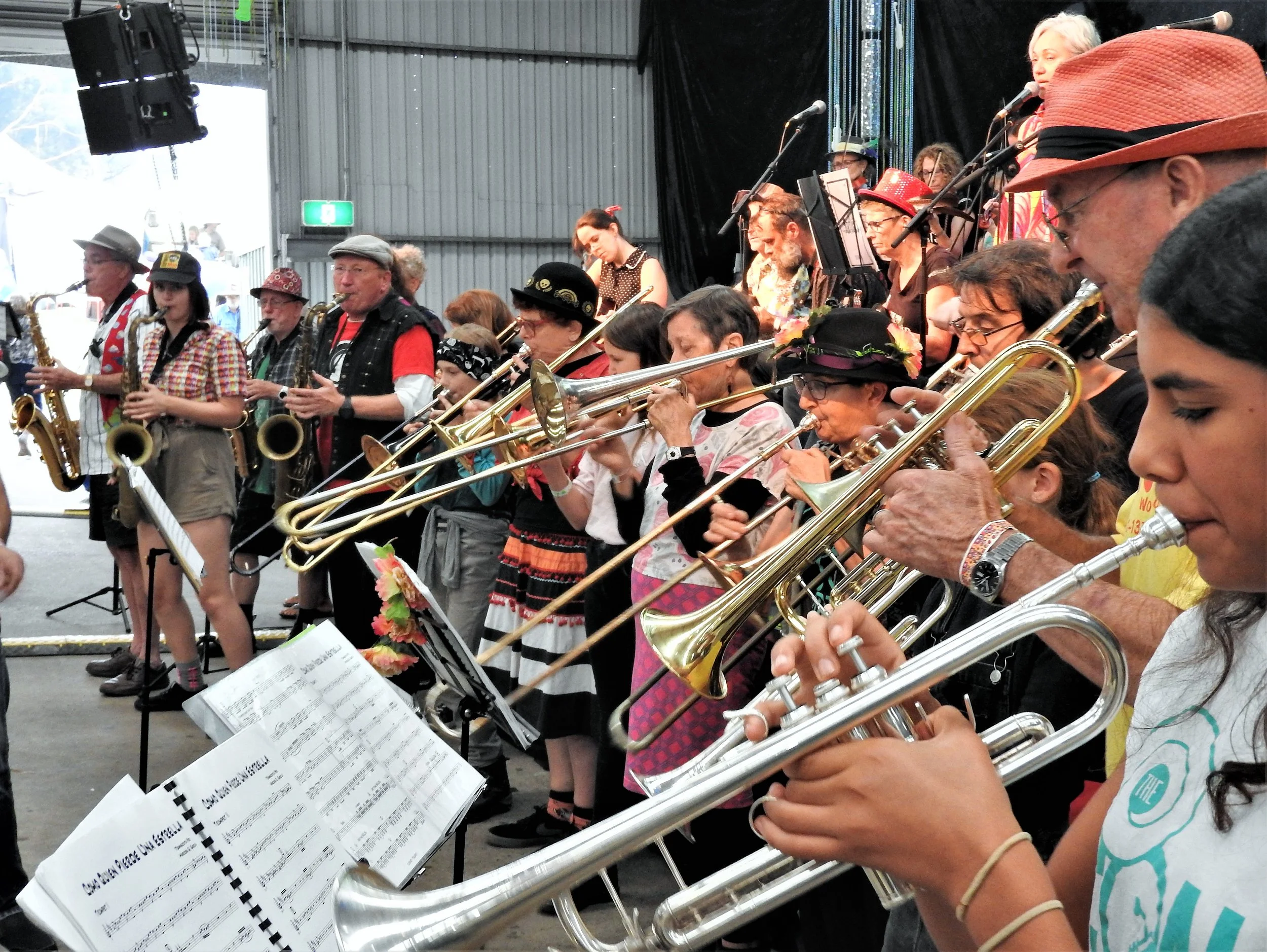
The Con Artists 2020
There have been highs and lows caused by weather events, which can particularly affect day ticket sales. The 2012 festival was beset by flooding, with vehicles bogged on the oval. Judy Cork tells some stories: “To get onto the middle of the oval, we ended up getting straw and putting that down as a base. And that worked, but of course, the greyhound people wanted us to clear it all up at the end. That was a big job. But the main thing was that when the greyhound tractor went over it, the tractor caught fire because the straw got too hot!
Also one of the stall holders, who didn't want to leave when they should have, got bogged. And there was a rule that we had to be off by a certain time for the greyhound races. So he was left there, and he was stuck for three days, and the night they televised the greyhound races, there's his van still on the oval!”
In contrast the temperature reached 47 degrees the next year, before a dramatic southerly change hit in the evening and blew over some of the merchandise stalls.
The 2013 festival featured the new Youth Traditions awards to encourage young artists to perform folk music. Ann Lehmann explained the concept was to encourage young people to play folk music. There were five categories: Australian folk song, folk song from another culture, folk tunes and then original tune in a folk style and original song in a folk style, with $100 cash for each category.
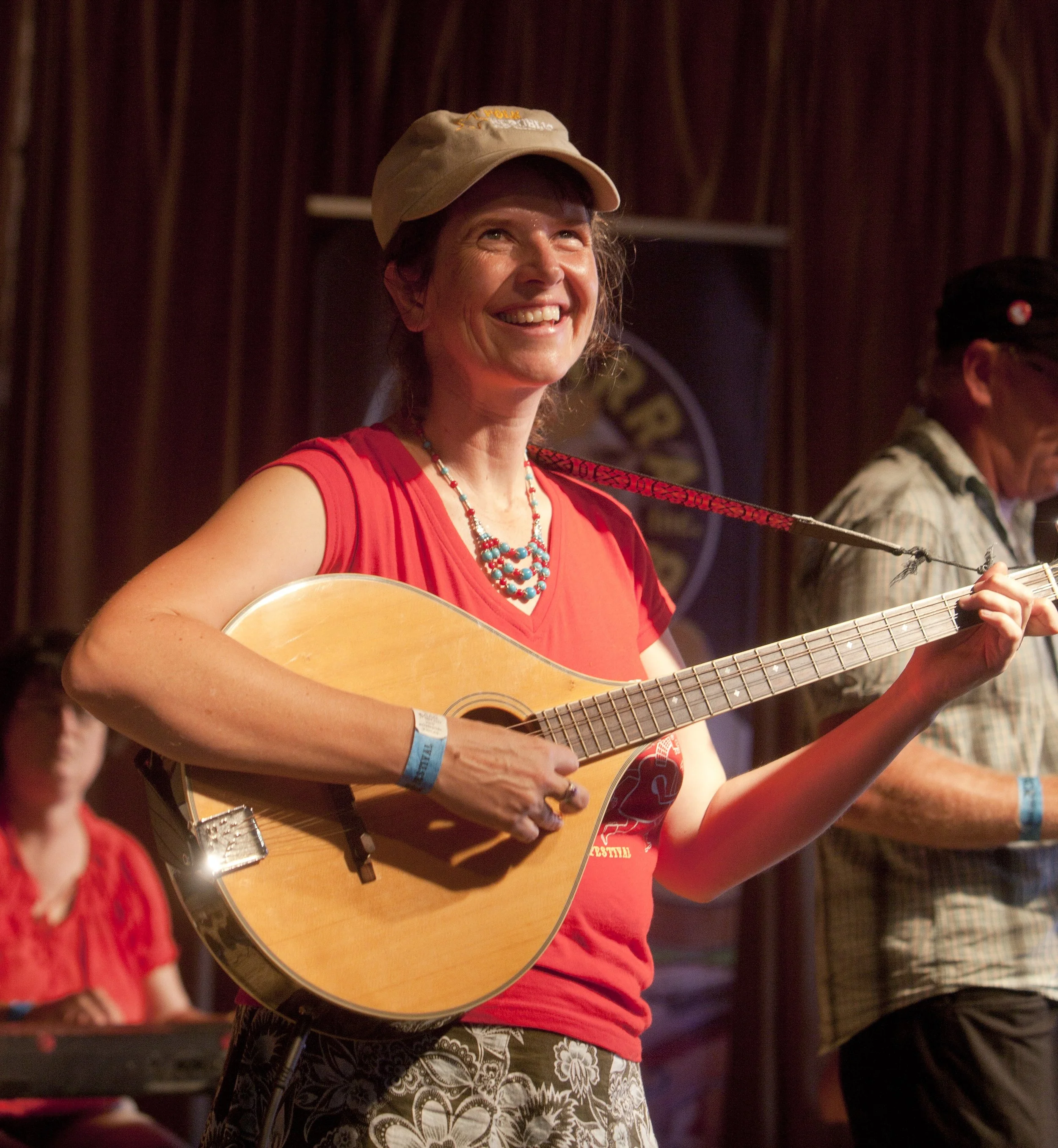
Ann Lehmann 2011
Relations with the greyhound people improved when Darren Hull became manager in 2014. But support for greyhound racing was declining, one of many factors affecting the future of the site. Aware that the site was “undervalued and underutilised”, he encouraged other users to stage events there. He thought the venue gave the festival character and was touched by the Instrument Lockup's use of greyhound racing terminology ('Race 1 Kennel 8') to assign spaces for artists to leave their instruments. The festival continues to work well with Darren and GBOTA, but their tenure is not secure as the industry struggles for survival.
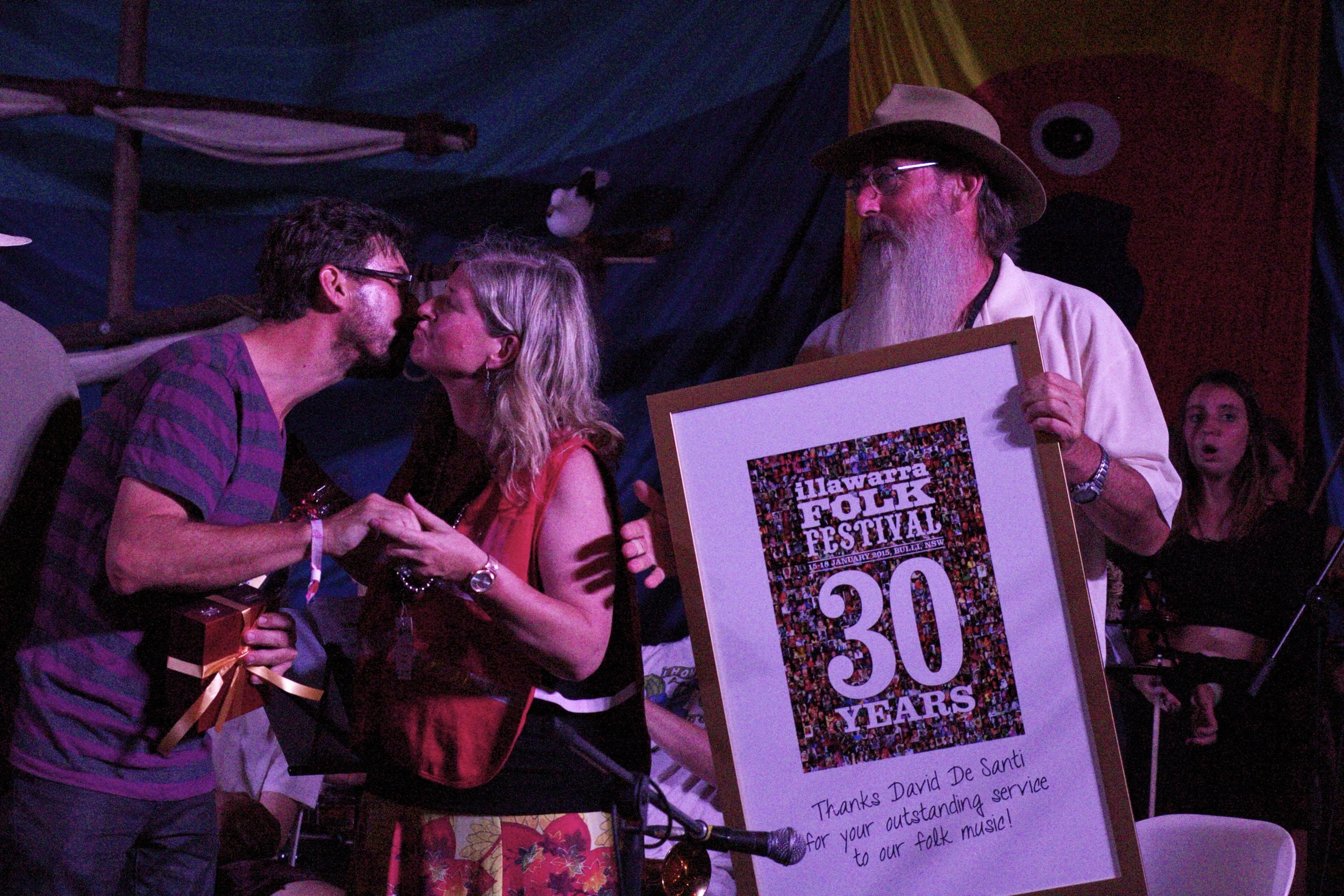
The festival has a tradition of celebrating landmark events such as the 30th anniversary in 2015 (and this year’s 40th anniversary. The 2015 festival was a 'pearl party' with masses of Mardi Gras beads given out with tickets and some pearl-themed content. This included a pearl ball, party parade, jam and song swap as well as the King and Queen of Pearls roaming the site. In the program David described some new elements: another venue, song-writing circles and the Folkaphonic Youth Orchestra. He said: “All this is part of the monster cultural event the festival has become. Here's a few statistics: 180 acts from all over the world and Australia with 89 of them local, around 800 performers, 540 concerts/dances/sessions/workshops and 13 venues.” There were 10,000 patrons over the festival period. Organisers introduced an anniversary water bottle in the hope that by the following year the festival would have no disposable water bottles. The core of 40 volunteers who had worked on various aspects during the year became an army of 400 for the actual festival, a very large number to recruit and manage.
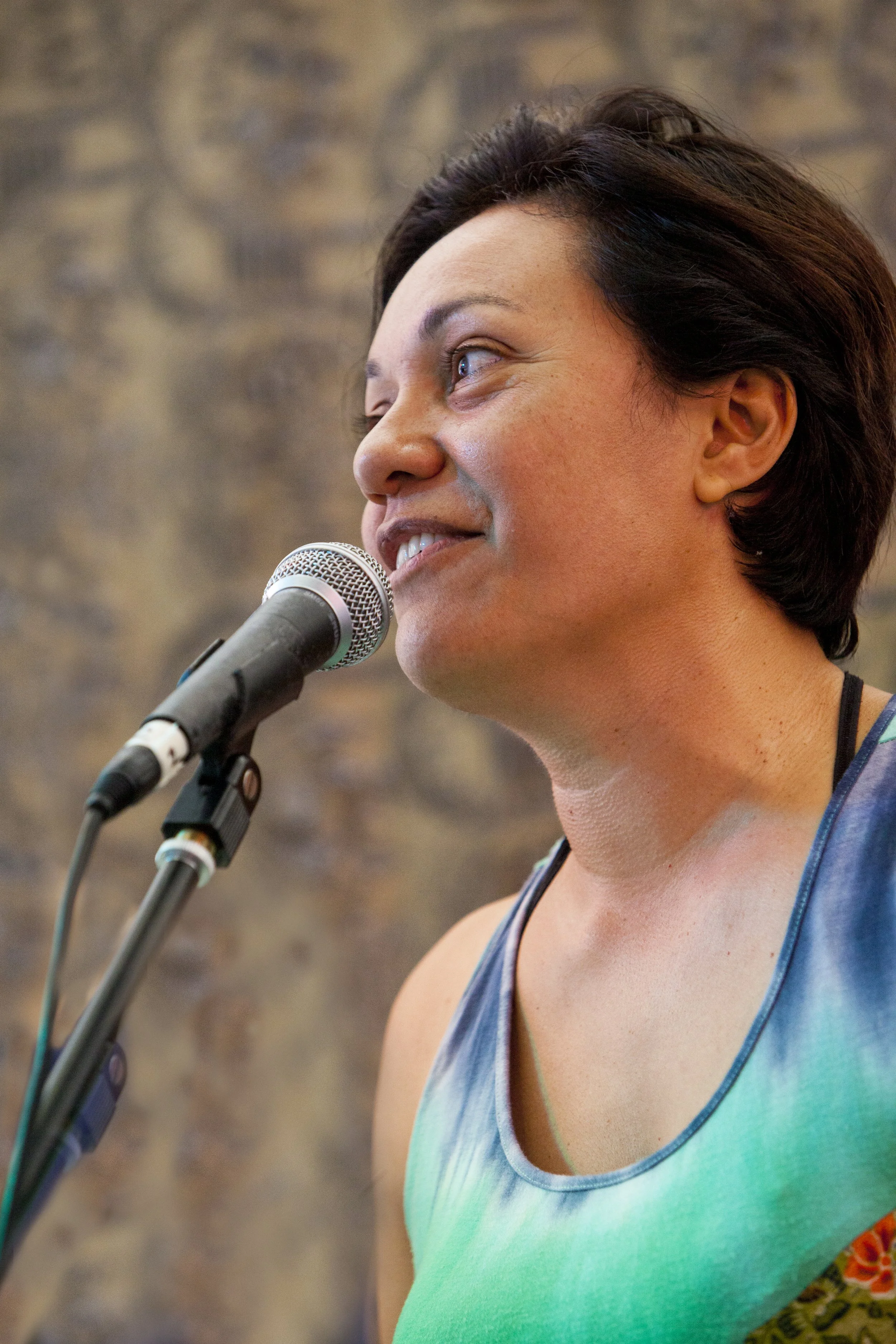
Lotte Latukefu 2013
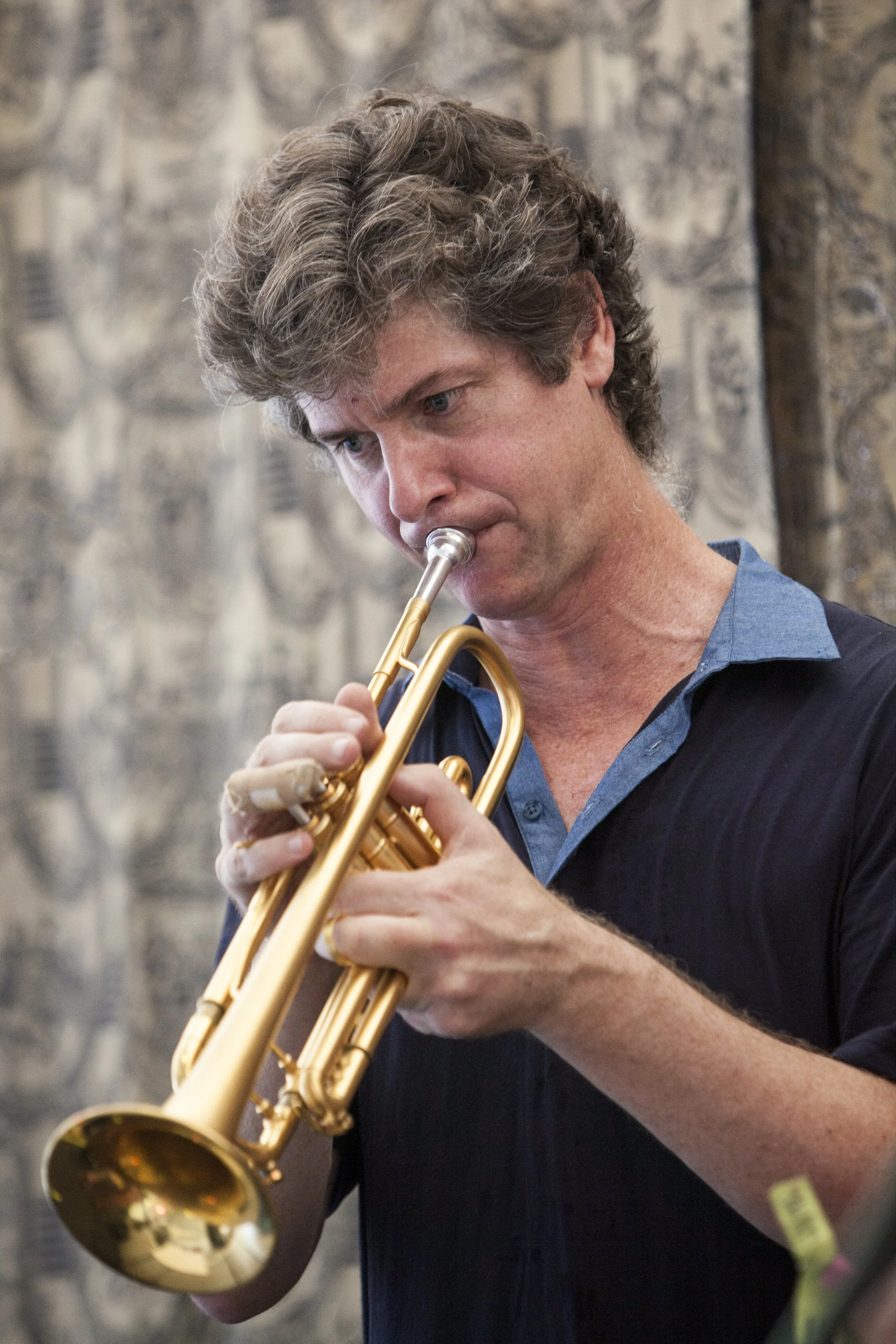
David Rooney 2013
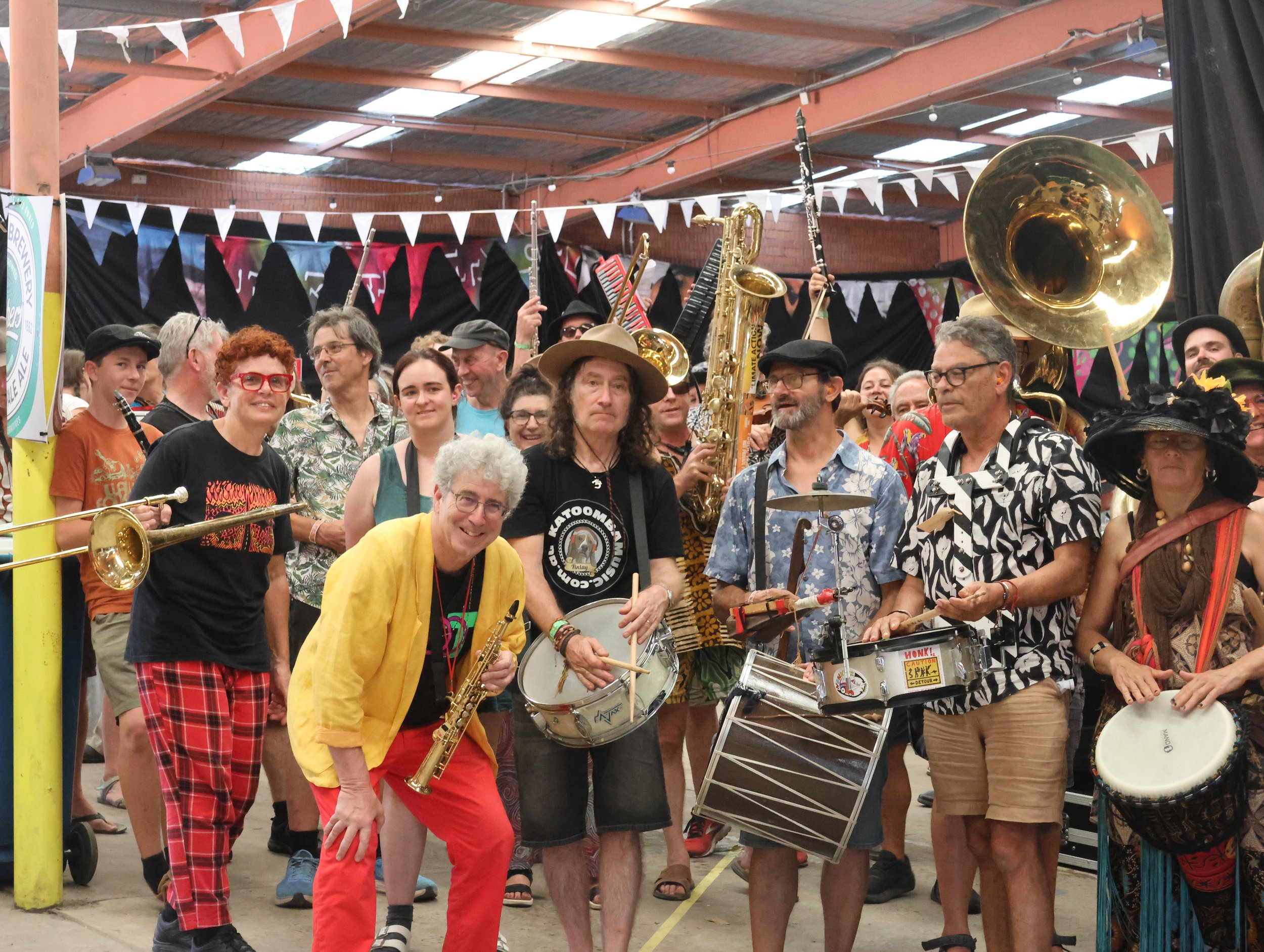
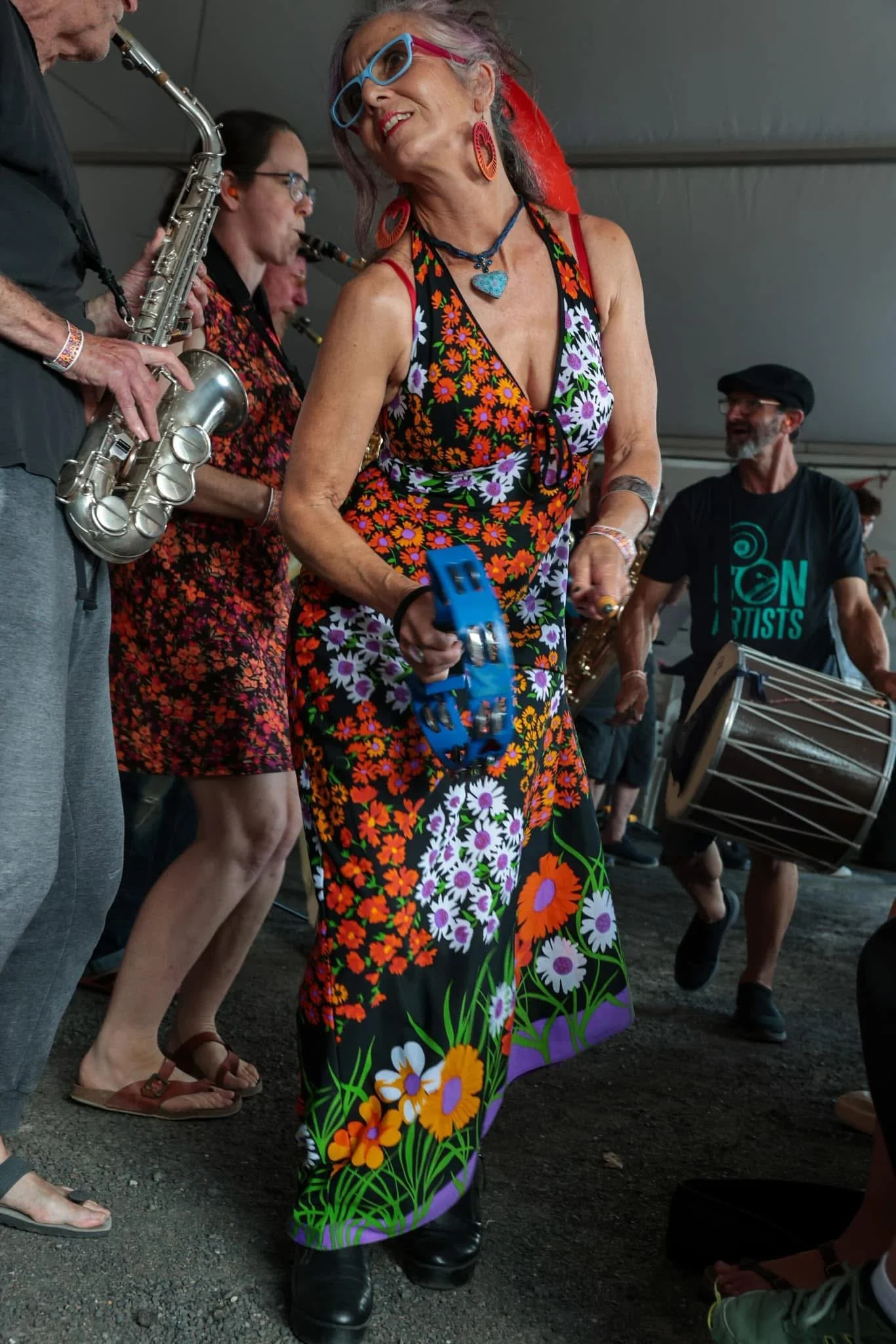
Ken Field’s Hoot Band 2024
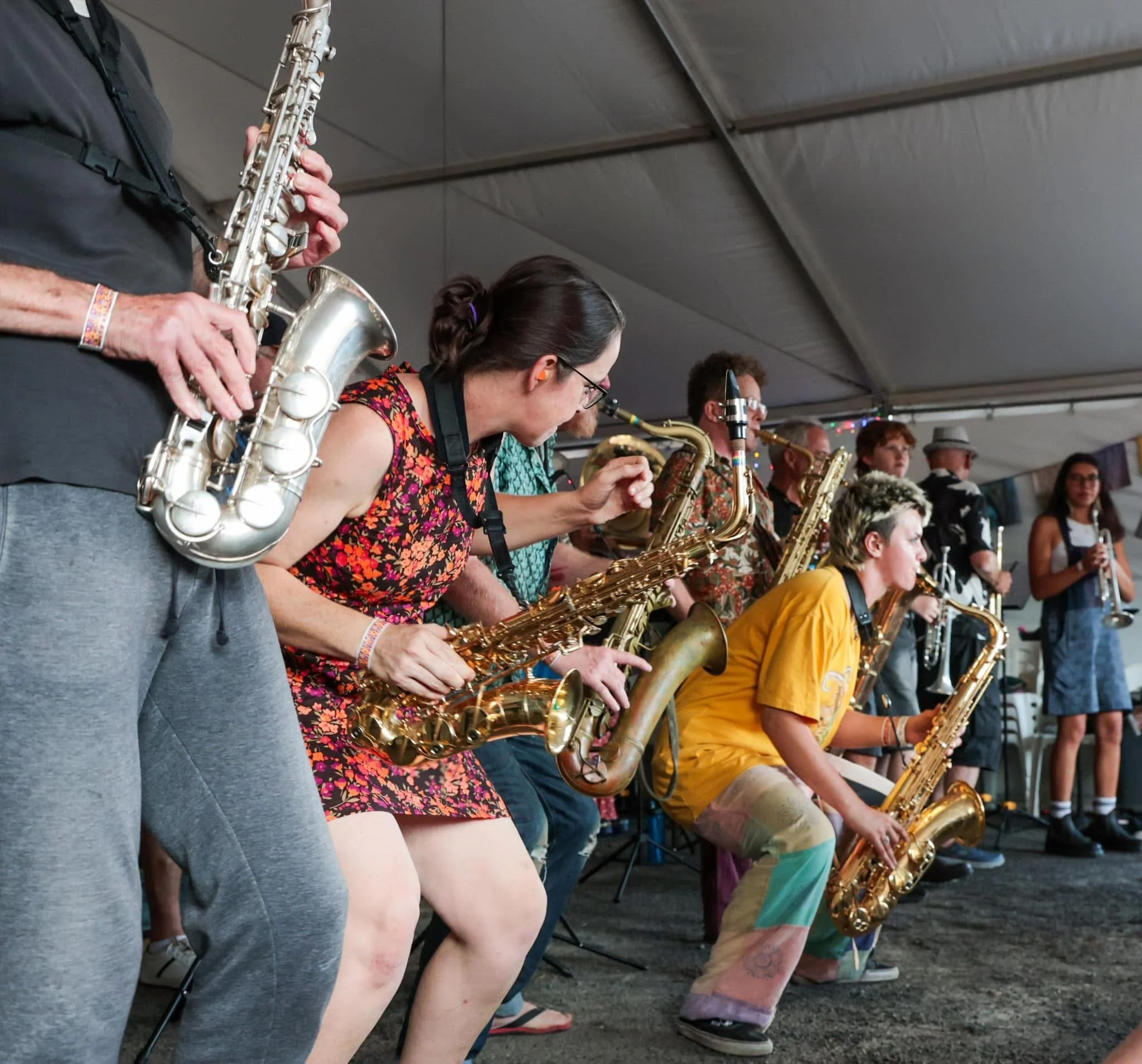
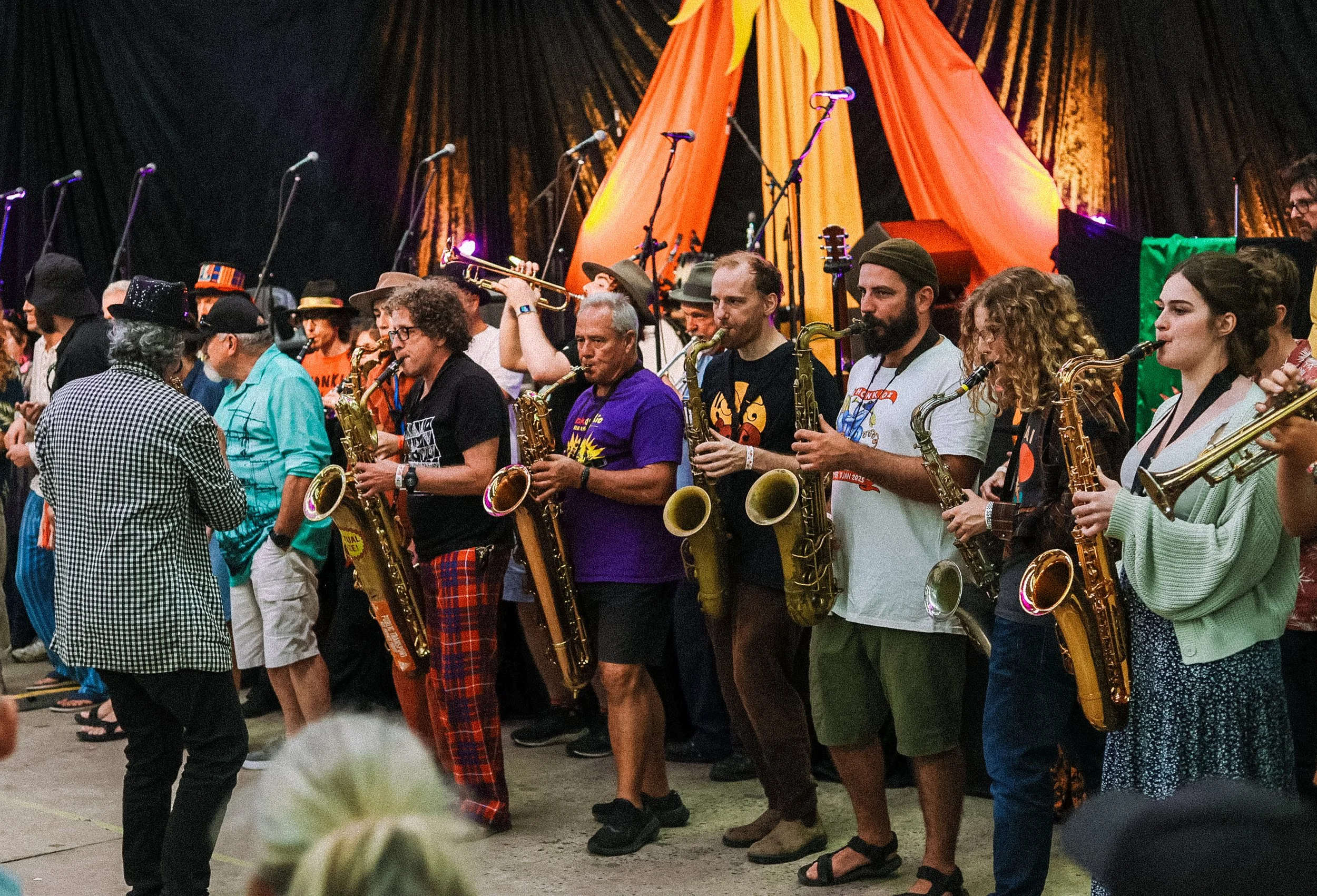
The HONK! Festival came to Wollongong in January 2015 and was a fringe event of that year’s folk festival. Directors David Rooney and Lotte Latukefu made this happen after learning about the success of Honk in the US. They explained that Honk bands take their musical inspiration from Mardi Gras and Carnivale and from street music gatherings across Europe and South America. Instruments tend to be brass and percussion, with performers dressed in flamboyant costumes. Founder Ken Field brought several US bands with him in 2015. He has returned many times since, leading sessions at the folk school and running Honk Jam performances throughout the festival. The colourful street music has acquired a place in the program and has brought many new performers and fans.
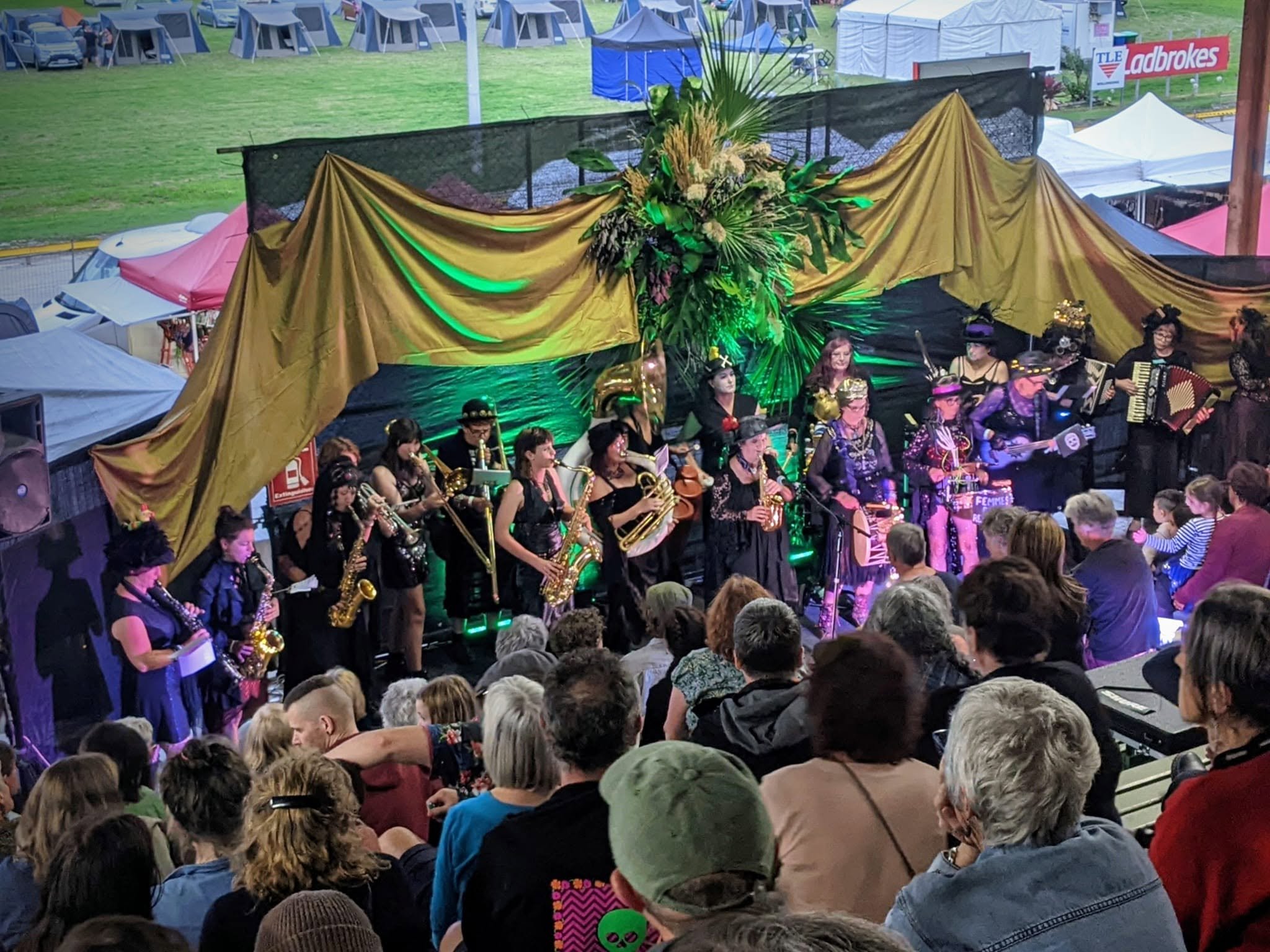
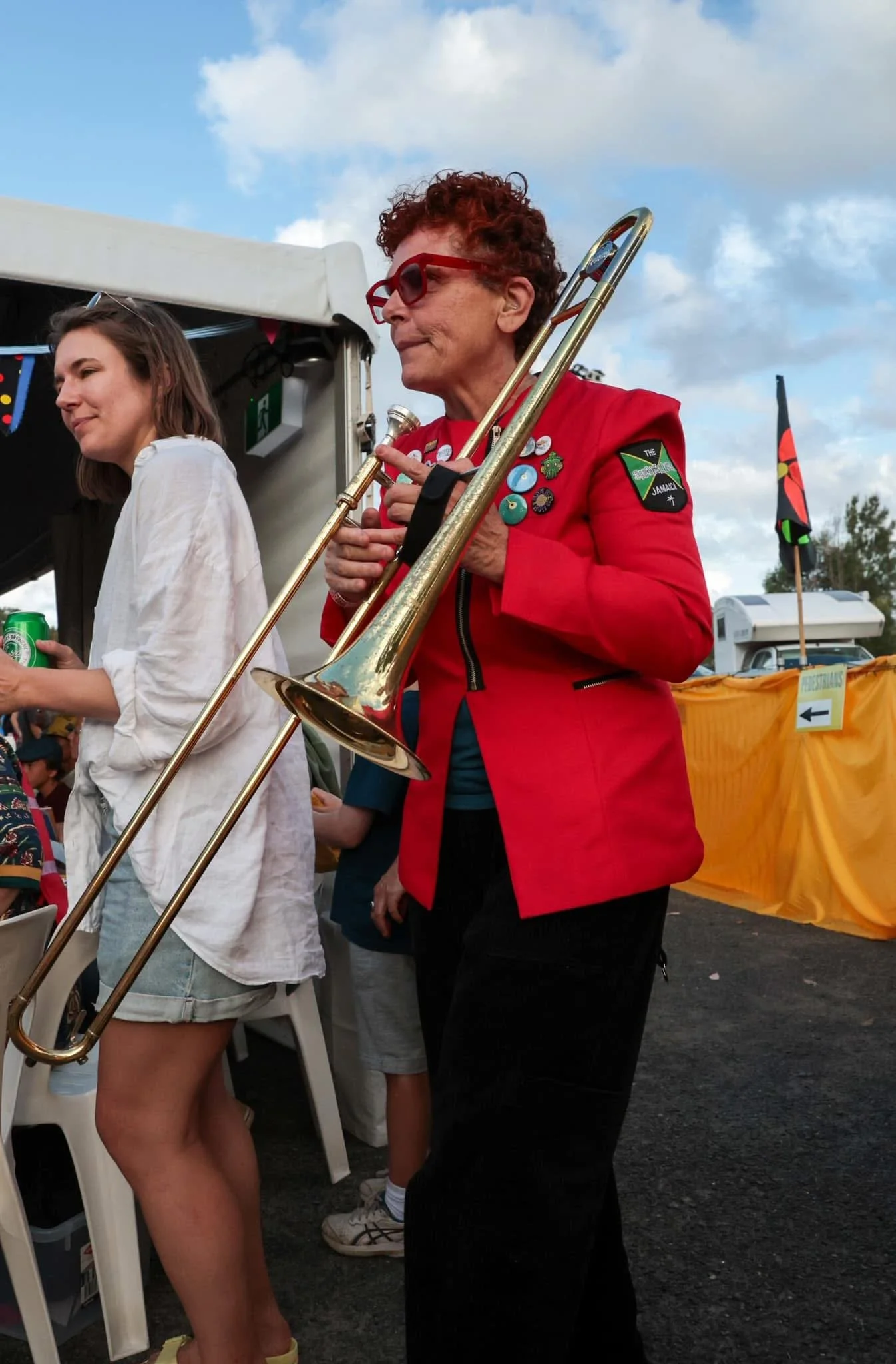
The Femmes Fatales 2023
Accomplished local musician, performer and music educator Mel Wishart embraced the style and formed a women's Honk band, Femmes Fatales. “I think it was George Brandis (Arts Minister) cutting arts funding and I went to a couple of Sydney rallies and got involved with protesting musically and so, I thought, right. So, I just married the ideas of women protesting, the Honk festival and arts funding. I gathered some women friends, handed out a trombone to that person and said, ‘Come on!’ [laughs] You know you can play those drums! You know you can do this; you know you can do that. Are you with me? Yes, you’re with me. The theme tied in with what goes on in my world I guess and my community. My friend Jenny Briscoe was starting up Tender Funerals and there was a mention of a funeral band and then I went right, we’re going to have a funeral for arts funding and we’re going to do it at Honk, and that’s where we started.”
The festival recorded a large financial loss in 2016 and in his president's welcomes in the program booklets Russell reported more 'financial drubbing' in 2017 and 2019. It was a difficult time for festivals, with many being cancelled. David De Santi moved to Queensland in 2017, which prompted further delegation of his responsibilities for planning and setting up the site. He remained artistic director and continued to do this as well as other tasks which could be done remotely, such as designing the program book, which he still does. He had taken on programming the Peak Festival in Kosciusko National Park and later Maleny festival in Queensland, as well as many activities in Brisbane's lively acoustic music scene. Back in Bulli, Neil Rowsell's role as project manager expanded. He co-ordinated planning tasks, as well as being operations manager at the festival, in charge of the team of shift managers.
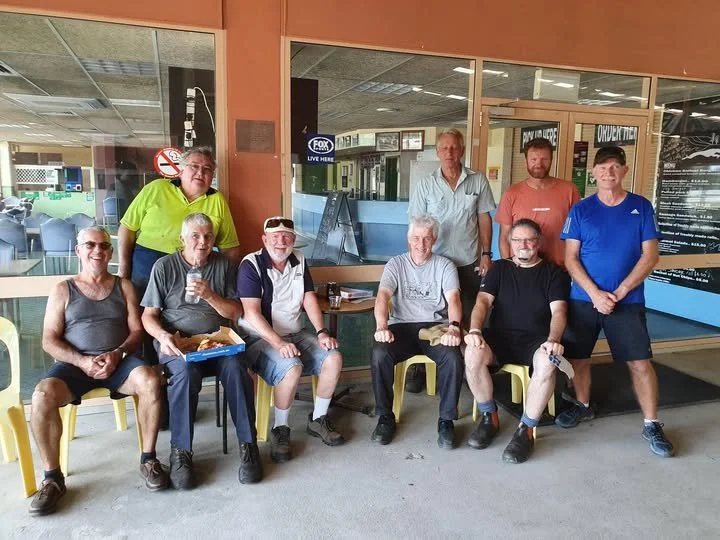
The 2020 Packdown Team, Neil Rowsell front row centre
The 2020 festival was the last 'monster' festival. Experience had taught us that bad weather can cause big losses and there was a general feeling that it was too ambitious and risky. Judy Cork says: “I think it took a few years to bed down (the Bulli site) and to work out how to do it, and I think then we became too ambitious. We tried to do something which was absolutely fabulous and big, but it was just too much for the key volunteers to control. It was such a big, big job, and it was managed well. There were people responsible for different areas and everything, but it was putting a lot of strain on people, and as the volunteers got older, it was just too much. And we were trying to do it to a high standard, as we should, but it was a very high bar to maintain.”
There are many great memories of that festival though, some captured in the Wollongong Library's Illawarra Stories collection of interviews Illawarra Folk Festival – Wollongong City Libraries Illawarra Stories. Gail Norris describes one: “I was MC last night for Cigany Weaver, one of the most electrifying performances I have seen in a while. They’re wonderful. The audience was dazzled. And the virtuosic performance of those musicians just had me blown away. I peeked out the side of the tent and there’s a beautiful meadow out there and it was dusk, so it was just starting to get dark and I call them the festival sprites, that is the little ones of the festival, ages three through eight probably, face paint, glitter in their hair, some of them had fairy wings and they were flitting around in the meadow like, truly like little sprites with the background of that glorious music. It just blew me away.”
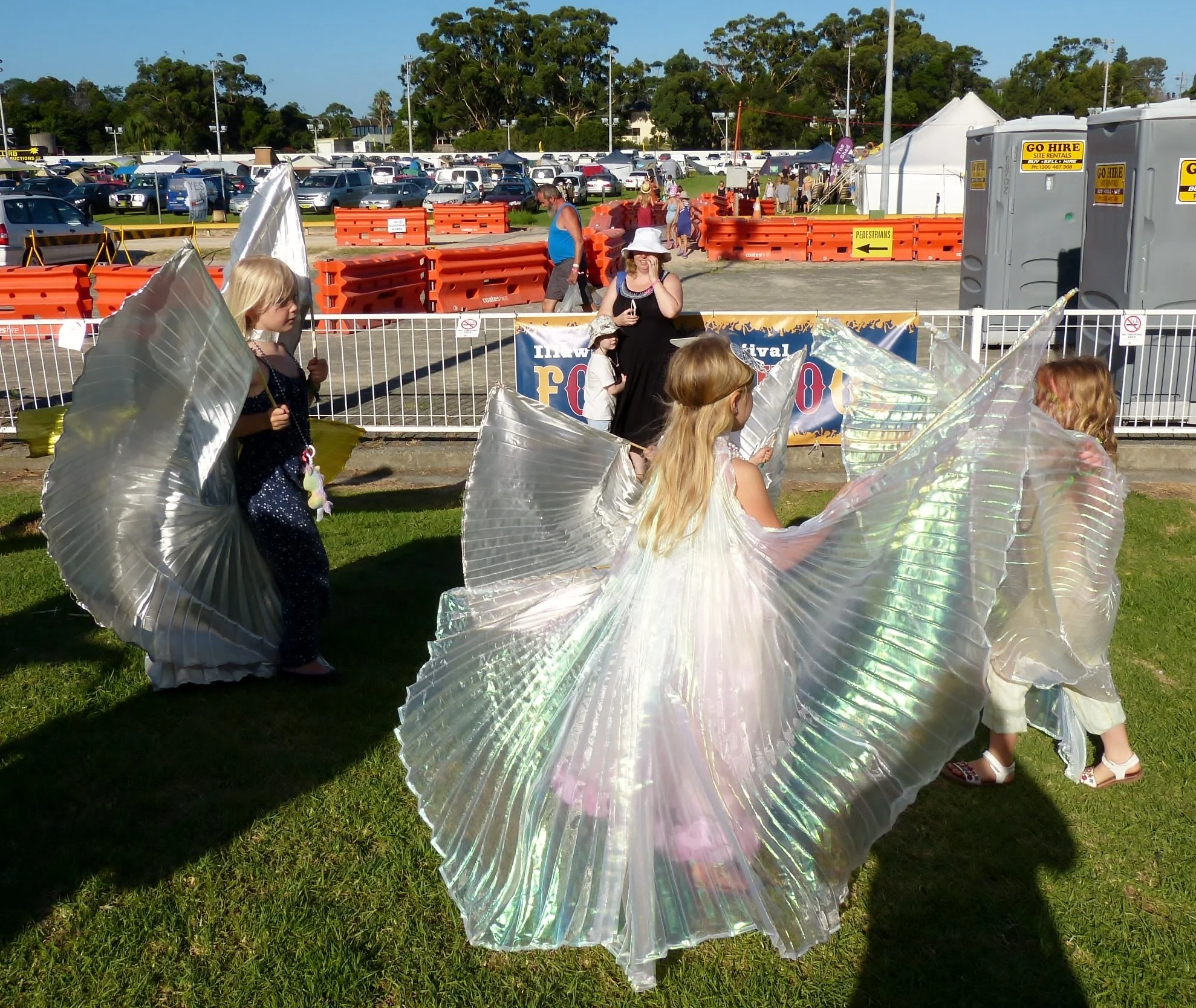
Fairy wings 2015
And from young performer Melanie Stjepanovic: 'Well, like the first night I came, fantastic. I went and saw an indigenous elder, Brian Morley, he was playing and that was fantastic. Then I went on to another area and Anna Smyrk was talking about the state of the world and climate change and all of that. And then moved on to another stage and Cigany Weaver were just like killing it on stage. And then went over to Kay Proudlove, and she’s local and she’s fantastic. After that I saw a German band. It’s just great that you can kind of just see so much in such a short period of time. I think that’s the reason I always come back, because I feel like I’m missing out on something if I don’t come.'
After Covid
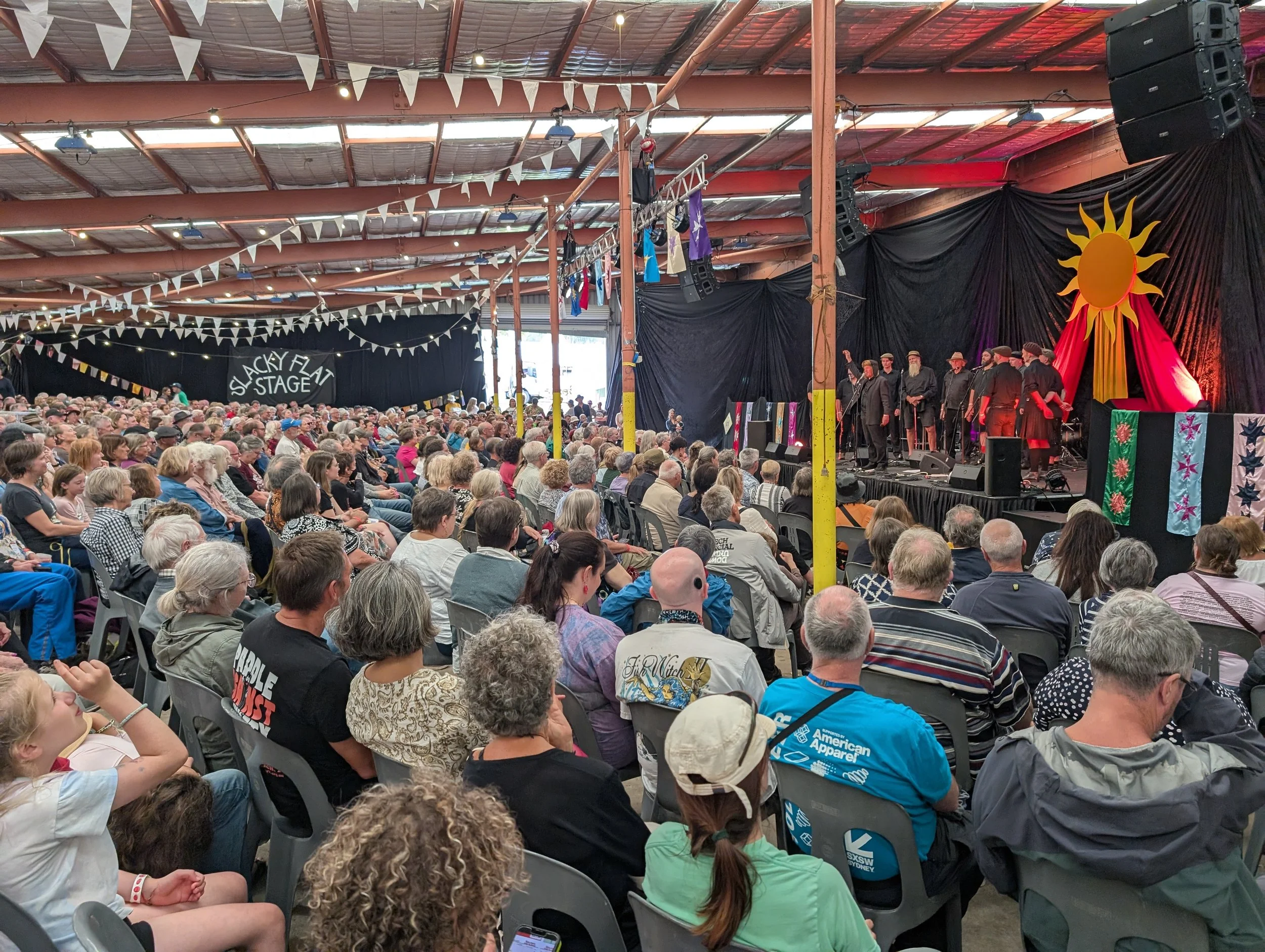
Then came COVID, which had a catastrophic effect on live music, with no festivals in 2021 and 2022. Some of us cautiously regathered during 2022 to plan a scaled down and rejuvenated festival, with many new personnel including young directors. Cody Munro Moore was recruited as project director after David saw his work at the Cobargo Folk Festival. Kay Proudlove became co-artistic director with David. She had taken over from her mother Ann in 2020 the role of artist liaison and registration, after performing from a young age since 2006. Ben Davies took over sound and production, and later more and more of the logistics and site management. All are multiskilled musicians who continue to perform.
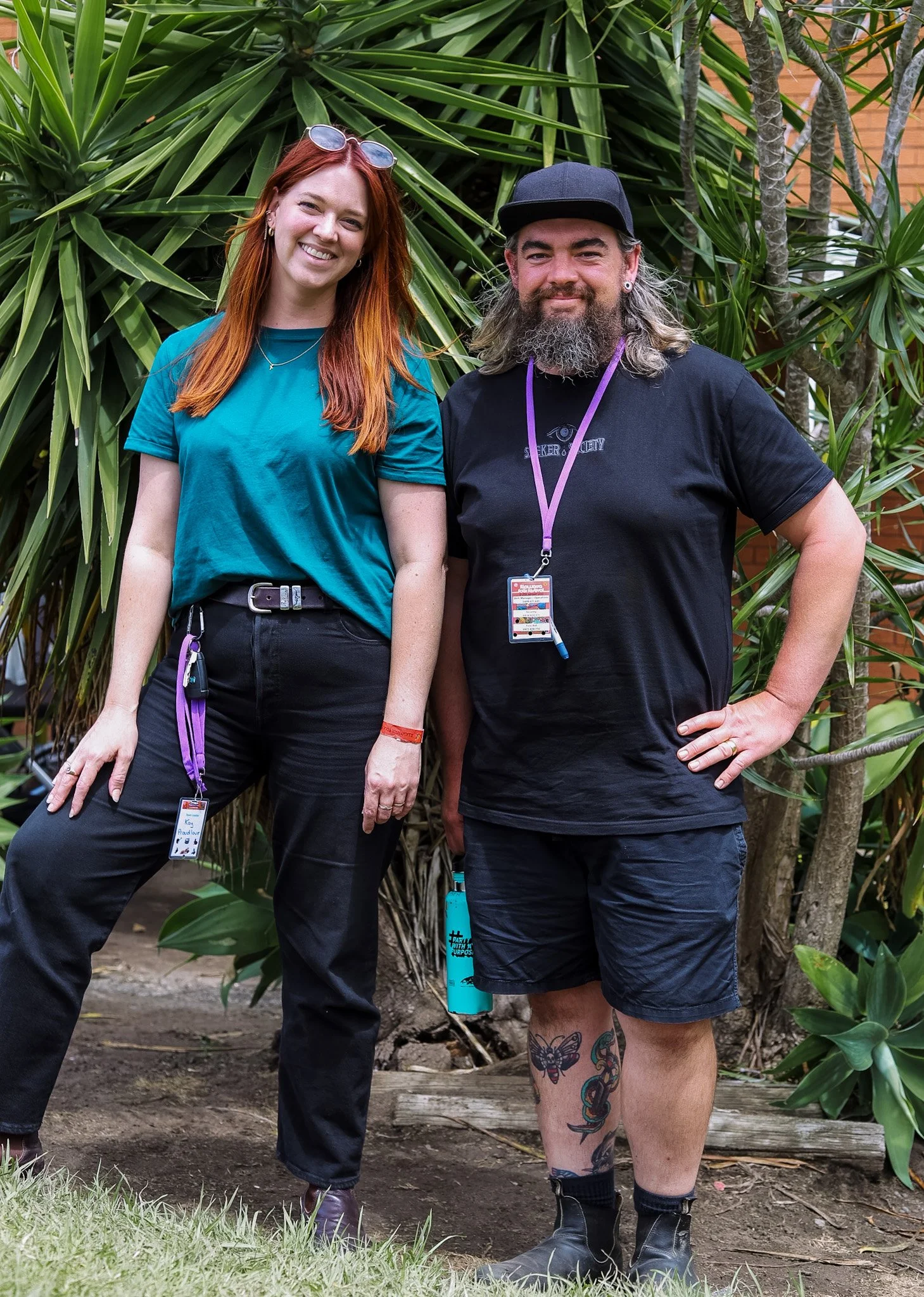
Kay Proudlove and Ben Davies 2025
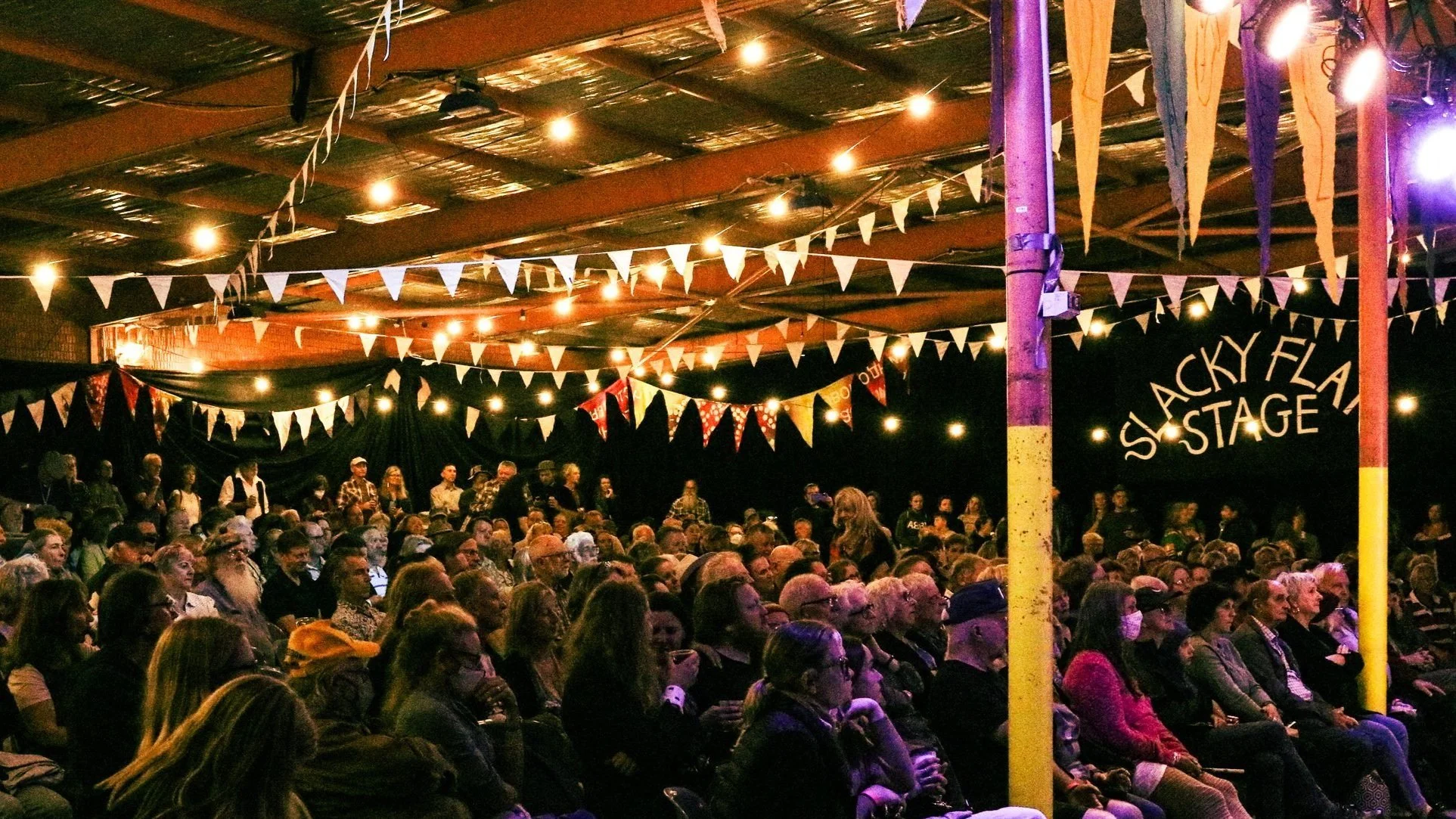
There was to be only partial use of the site. There would be fewer venues, performers, activities and volunteers with less cost and risk. In contrast to the five-day events we'd got used to, this one would only be three days including the one-day folk school. Whereas the program booklet had grown to 66 pages in 2020 with a great deal of advertising, this one would be 16 pages with no advertising. There were only five venues, all clustered around the Slacky Flat area. We lost the beautiful Grevillea Park venue, but that reduced the work and expense involved. The target number of volunteers went from 400 down to 250, which was easier to achieve. There were only 70 acts, 50 per cent of them local. There were no extra events like the charity night and tripe nights, no participatory festival choir or orchestra.
We had no idea whether loyal festivalgoers would be satisfied with this scaled-down version and were pleasantly surprised at how well it was received and how manageable it proved to be for us. We felt the festival was on a good path for the future and there has been only incremental growth since, with two extra venues added on the oval and behind the stables. The charity concert was re-established in 2025. But it's agreed any growth will be taken with caution, and we don't want to extend the festival's length.
Some areas have required people to learn new skills, such as online ticketing and finance. Some activities, such as the festival shop, have changed focus. Traditionally the merchandise was primarily CDs and T-shirts. Shane had an increasing role in decisions about the T-shirt design and production. While they continue to be popular, CDs of course are not. Shane says: “We used to print a lot of CDs as it was quite an economical process, but we would always have an abundance of them. But not a lot of people own CD players anymore so we've stopped CD production and that's made an impact on the types of merchandise. We're seeing a lot more of the artists providing a variety. So not just a T-shirt, a CD … we're now seeing handmade jewellery, tote bags, tea towels, stubby holders, stickers and diaries. Even Kay Proudlove had drink bottles one year. I still have mine, they're fantastic.”
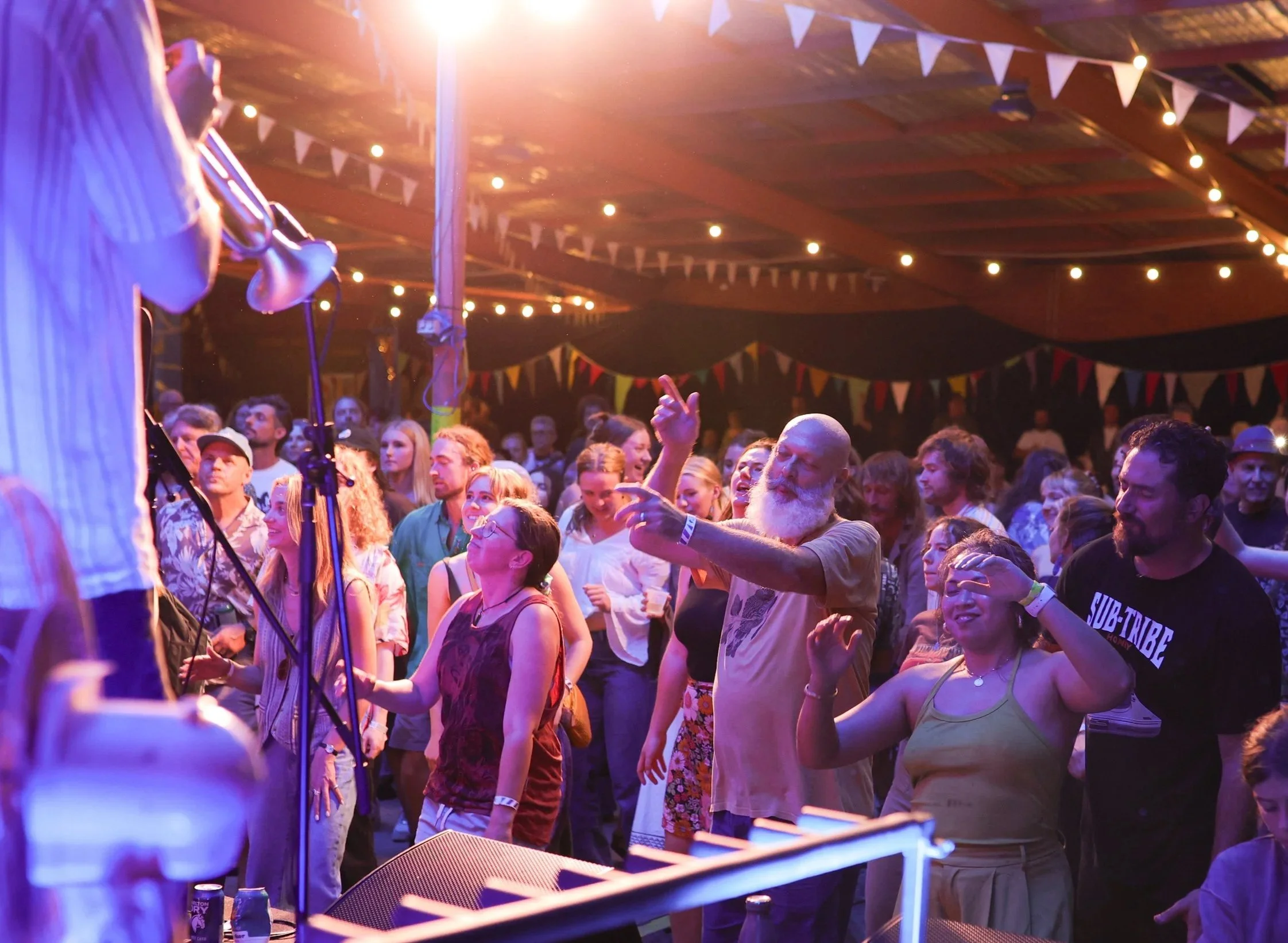
Graeme Morrison thinks Illawarra is unusual among folk festivals in the degree of succession achieved. Younger performers now have an influence on the selection of artists and programming. One innovation has been a Friday night show featuring a popular party band, playing a one-off set as a special event to attract a different audience. The sets by the Afrobeat band The Strides in 2025 and reggae band Sub-tribe in 2026 were very well received.
The 2006 program book listed 28 roles in the festival committee, and 59 by 2016. These roles were scaled back to 48 by 2026. Of the names listed in 2006, only eight reappear in 2026, and all (except me) were involved in Jamberoo days. David, Russell, Graeme, Bruce and Robyn, Tony and Ann have all demonstrated exceptional commitment and staying power. Others have played key roles for shorter periods and handed the job on, and more roles have been created. Tom O'Toole took on some of Rod's jobs in site planning and setup, later replaced by Todd McCoy, who brought his Sydney Opera House experience. Some musicians have stepped into organising roles, such as Al Yorke (marketing), Ryan Church (volunteer manager) and John Littrich (production).
All the time the festival has been at Bulli there has been a major uncertainty over the future of the site, because of increasing calls for a road easement linking the Northern Distributor (Memorial Drive) to the bottom of Bulli Pass, to relieve traffic congestion between Bulli and Thirroul. There were fears that a road would be pushed through the middle of the showground site, which have broken up the unity of the festival and eliminated venues. Wollongong City Council had worked on plans for the site for many years and finally came up with Draft Master Plan in 2023. There were rumours that the greyhounds would vacate to Dapto and/or be closed down. The plan didn't accommodate our kind of festival, rather focussing on sports fields and one main stadium for outdoor concerts. We hadn't been consulted and weren't acknowledged as a major event and user of the site. We sent submissions to Council and Al Yorke spoke for us at a meeting. Council announced that it would not proceed until a decision was made about the Bulli bypass road.
Soon after, the NSW Government finally acted and started consulting the community. This led to the government in December 2025 ruling out building a road on the escarpment to connect Memorial Drive to the Bulli Pass or the M1, which opened the way for Council to proceed with planning for the showground. We can only hope that the redesigned and rebuilt site will still be flexible and affordable enough for the Illawarra Folk Festival and other community events. Wollongong needs a dedicated space where events like ours can happen, but this is challenging when public space is limited and many different uses have to be accommodated.
David has for a long time wanted the future of the festival to be more secure. He described his experience of going to the National Folk Festival in Canberra. “Walking into a venue such as the Exhibition Park in Canberra always makes me envious. It has a huge camping area, a number of buildings for venues, a fence and site control and the fact that it can be transformed into a musical and magical village without a huge effort. So that is my dream! A multi-purpose venue that we can utilise and make our huge volunteering effort so much easier, while still bringing a world-class event to Wollongong.”
Still, while definitely not being a world-class venue and sometimes compared unfavourably with the 'magic' of Jamberoo, Bulli retains its distinctive character as a summer festival setting. Kathy Orton says: “The folk festival site at Bulli has a bigger footprint with room for quite a lot of campers and parking around the trotting track, and options for public transport. The extra space allows marquees to be more separated and there are a variety of venues for performances. It's close to the beach, the Grevillea Park and Bulli village, so it seems to have more of a holiday atmosphere than Jamberoo had. As the festival has grown, so has the variety of music and performers. A parade at the end perhaps takes its influence from the HONK! festival - a lot of the same performers are at both events. So January in the Gong is hot and sunny and full of music and visitors.”
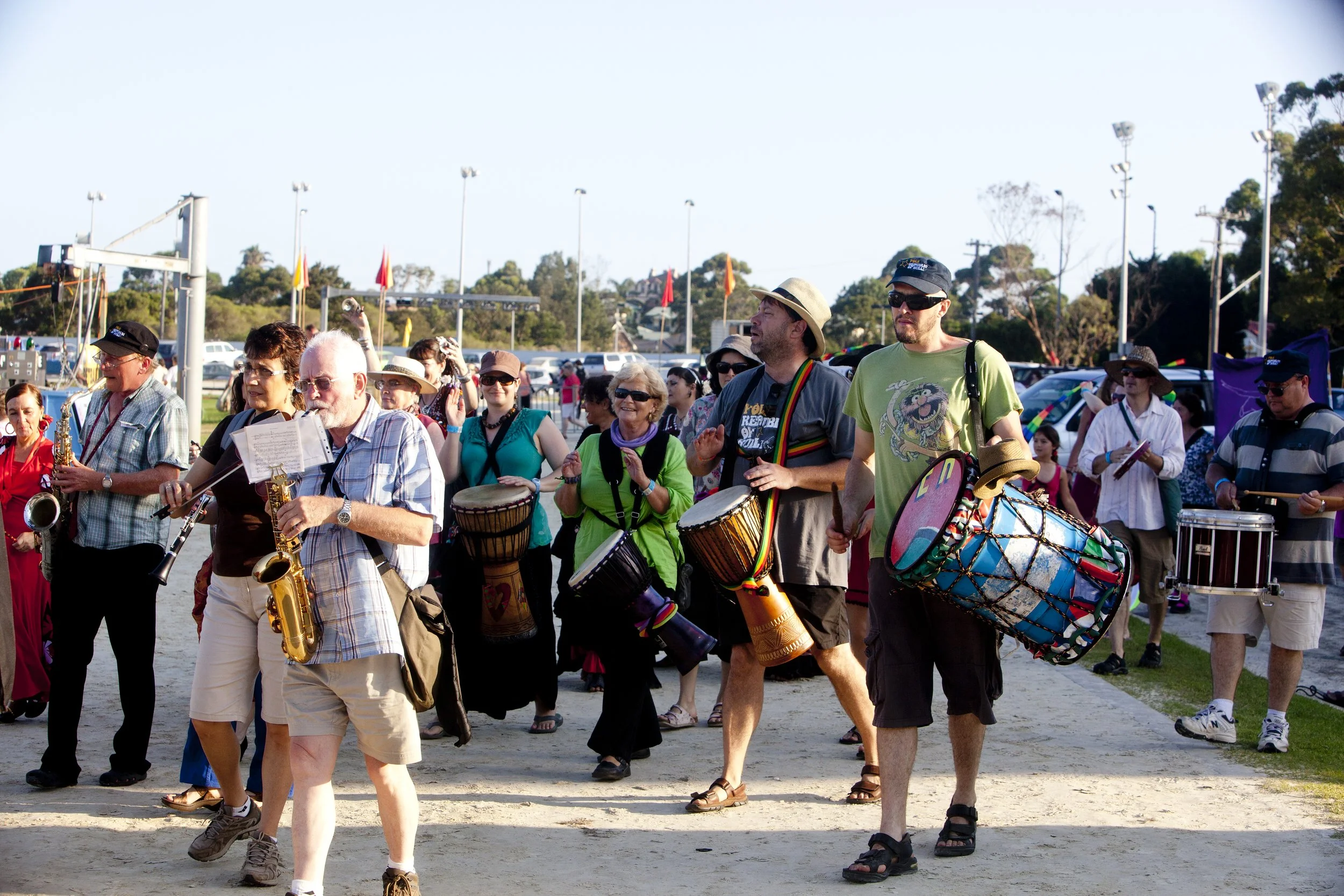
Parade to the finale 2011

Safety Officer Nik Diesel, Director Shane Moon and Setup Manager Todd McEvoy 2026
Shane Moon replaced Cody Munro Moore as festival director for the 2026 festival. With her performance rather than folk background, Shane is keen to see the street theatre and unprogrammed and interactive aspects expand. She supports the direction of the programming and pays tribute to Kay and Ben in particular, who have taken up the programming responsibilities in recent years. “I think where it's going is great,” Shane says. “I love that we maintain a certain tradition of the folk music, but also push some boundaries of where folk music sits and, you know, utilising a bit of world music and things like that. Because at the end of the day, folk music is very much about activism and telling a story. And so as long as those two main features are there and it's not outright pop music, I'm a happy person.” She would, however, like to encourage more Indigenous content.
Nick Hartgerink reflects on changes in his area: “From the point of view of publicity and marketing, it used to be just me sending out press releases, and now we've got a fantastic little marketing team of people who do social media, people who produce videos and ads for TV, and it's really done scientifically and professionally to a high level, with the website being so much better. It's allowed us to keep our head above water in a pretty difficult festival environment.”
The difficult environment has partly to do with funding. The Illawarra Folk Festival has a number of loyal sponsors including BlueScope and WIN and has had generous assistance from Wollongong Council and Destination Wollongong.
But, as Nick says: “It's really hard running festivals these days. There are so many costs involved and some of the popular music festivals get huge government subsidies, which we don't seem to be able to attract. Maybe we're not considered funky enough by the funding bodies. They want to appeal to younger people and show that they're caring about younger people. So, for example, Yours and Owls - I've got nothing against Yours and Owls, but they get hundreds of thousands of dollars to support their festivals. And that's amazing, but why shouldn't we get a bit as well?”
It's also about the weather as the festival is basically an outdoor event and the climate is changing. We've had dangerous heat, winds and rain which have caused a lot of work and angst but thankfully haven't yet led to serious incidents or cancellations. The 2026 festival was beset by heavy rain on Saturday night, causing tents and buildings to flood. That made us more conscious of our liability for the risks involved, and this led to instigating a risk assessment process and better planning for foreseeable disasters.
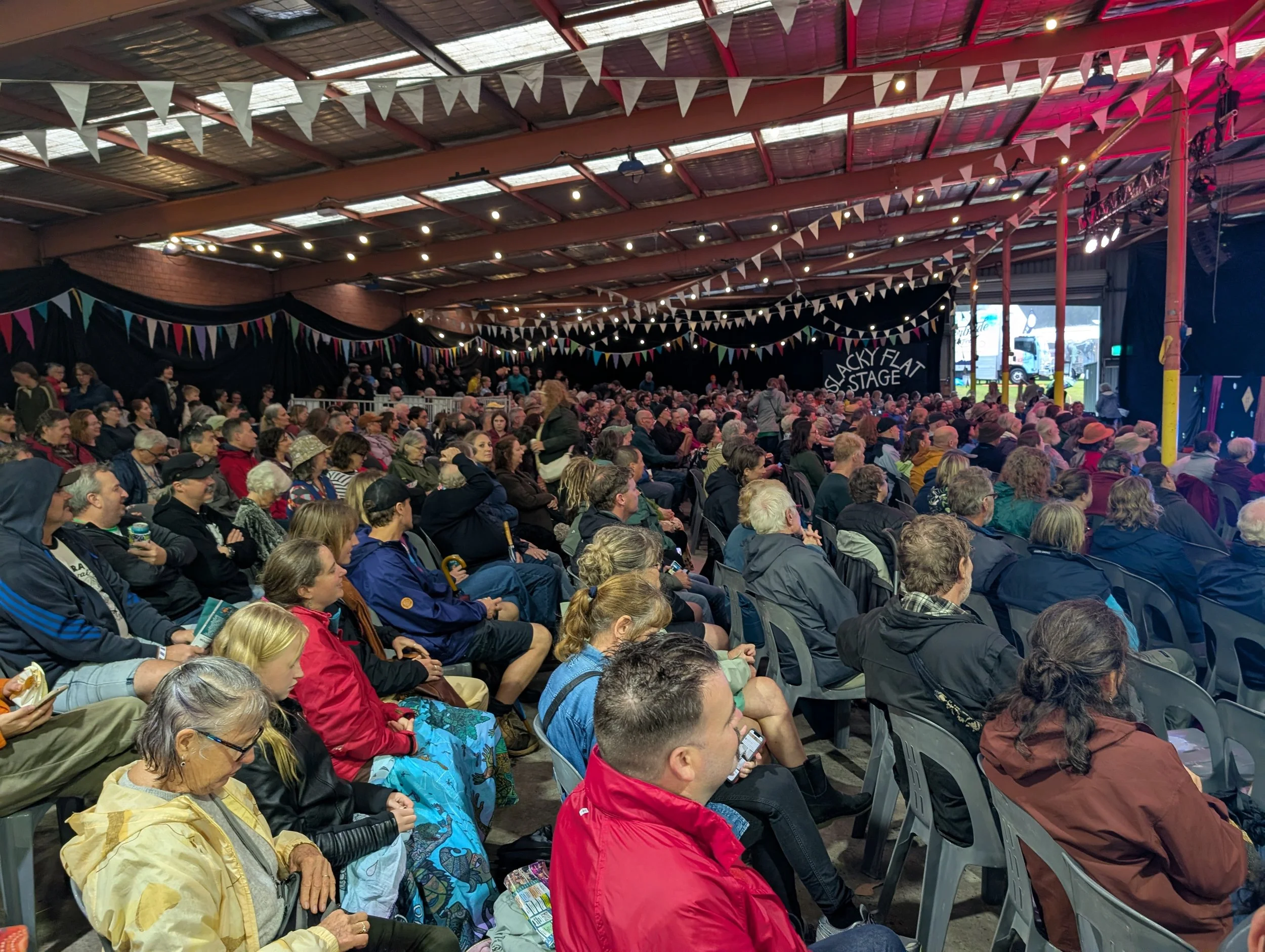
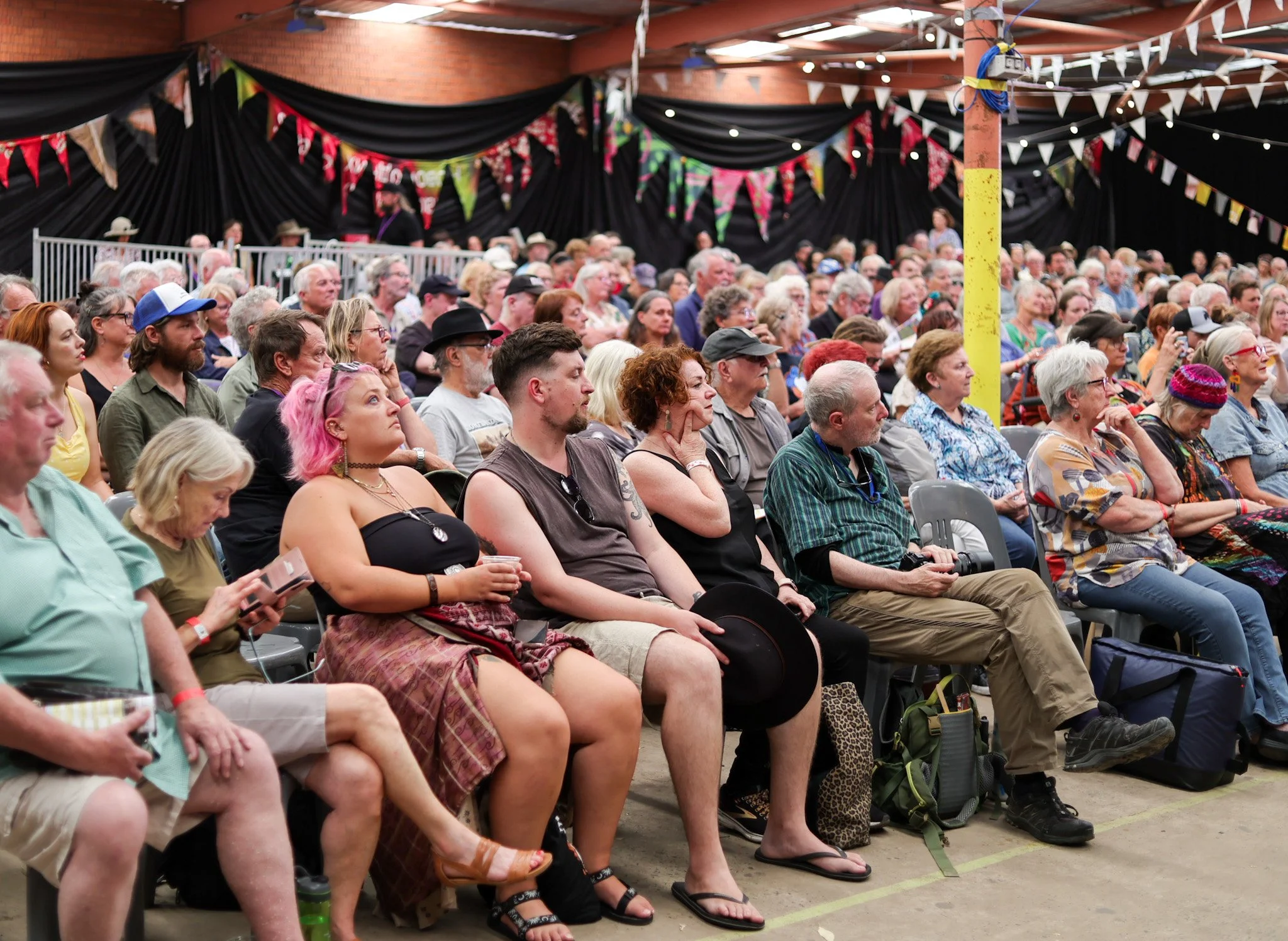
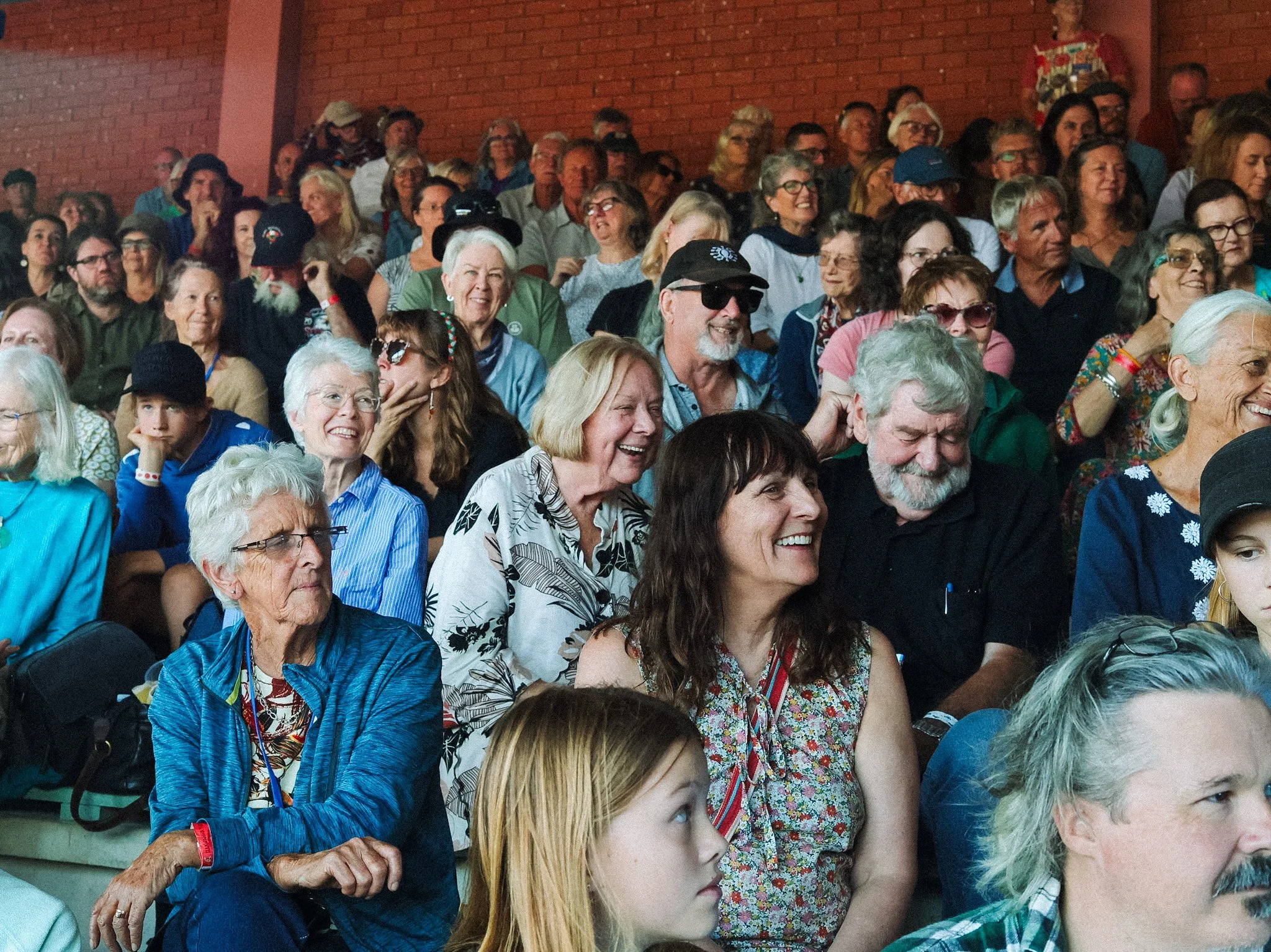
Audience in raincoats 2026
But we're all proud of this entirely volunteer run festival that we've all worked hard for. We think it has some great qualities, reflected in the number of applicants and the standard of their music.
Ann Lehmann is positive about the future as she's in touch with the festival's constantly developing young talent. She acknowledges the need to “hand over control to the younger people, which is always a little bit hard and can be a bit scary when people have got a particular idea of how to do things”. She also thinks we need to keep an open mind. “Folk music is music of the people, and that changes,” Ann said. “One of my favourite composers, Leo Brouwer, set Beatles songs as folk tunes (for guitar) because they are the music of our generation, they are the folk tunes of our generation. So it’s the songs that people know, and that's always shifting.”
Many attendees remark on the family-friendly nature of the festival, which provides children's entertainment and a safe space. Shane says: “It's become a family tradition for us and I've watched my kids grow up through it. None of them sadly are musos yet, we'll see how that happens for the future. Maybe one of them will become an organiser like their mother.”
There has indeed been generational change as offspring of festival folk or child performers have grown into major players. Shalani Thomas was the recipient of the first Youth Trad ‘best folk song’ award, performing in the trio Dear Violet. She now performs solo and with her band, conducts the Illawarra Union Singers and runs the Youth Traditions section. She says “the Illawarra Folk Festival was the first time I felt at ease and a sense of community around music. Until then I’d only experienced performing in competitive settings like talent quests. I stepped into the folk festival as a 10 year old and finally felt welcomed. Instead of everyone competing against you, everyone wants to lift each other up and just play music. I still feel that now and have never looked back. I’m forever preaching to everyone I meet to come along and see it for themselves! Many locals are unaware of the magical little world that arrives in our town each year, and I feel sad for them. It is so special and I feel lucky to be a part of it.”
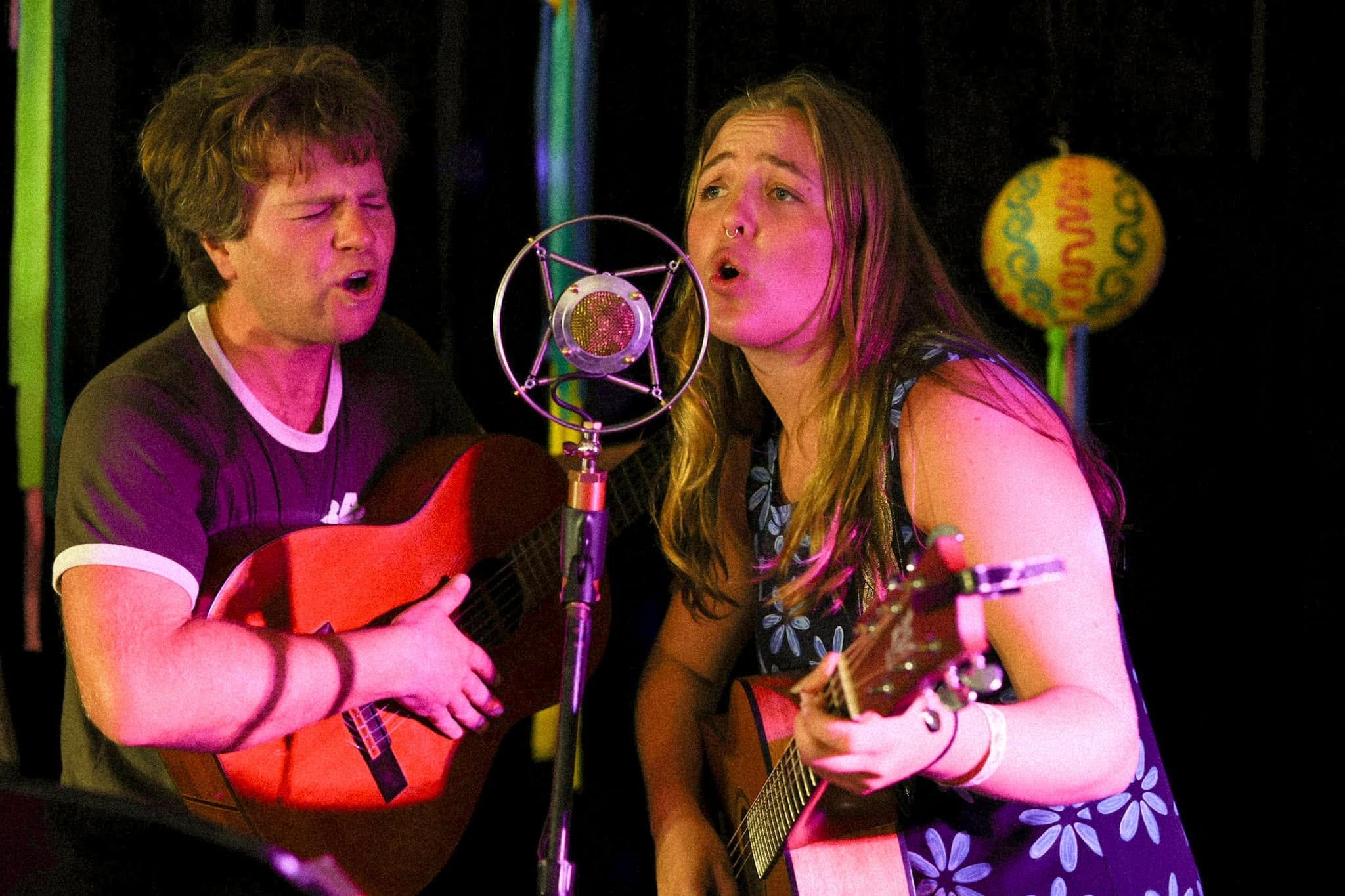
Cody and Shalani performing 2025
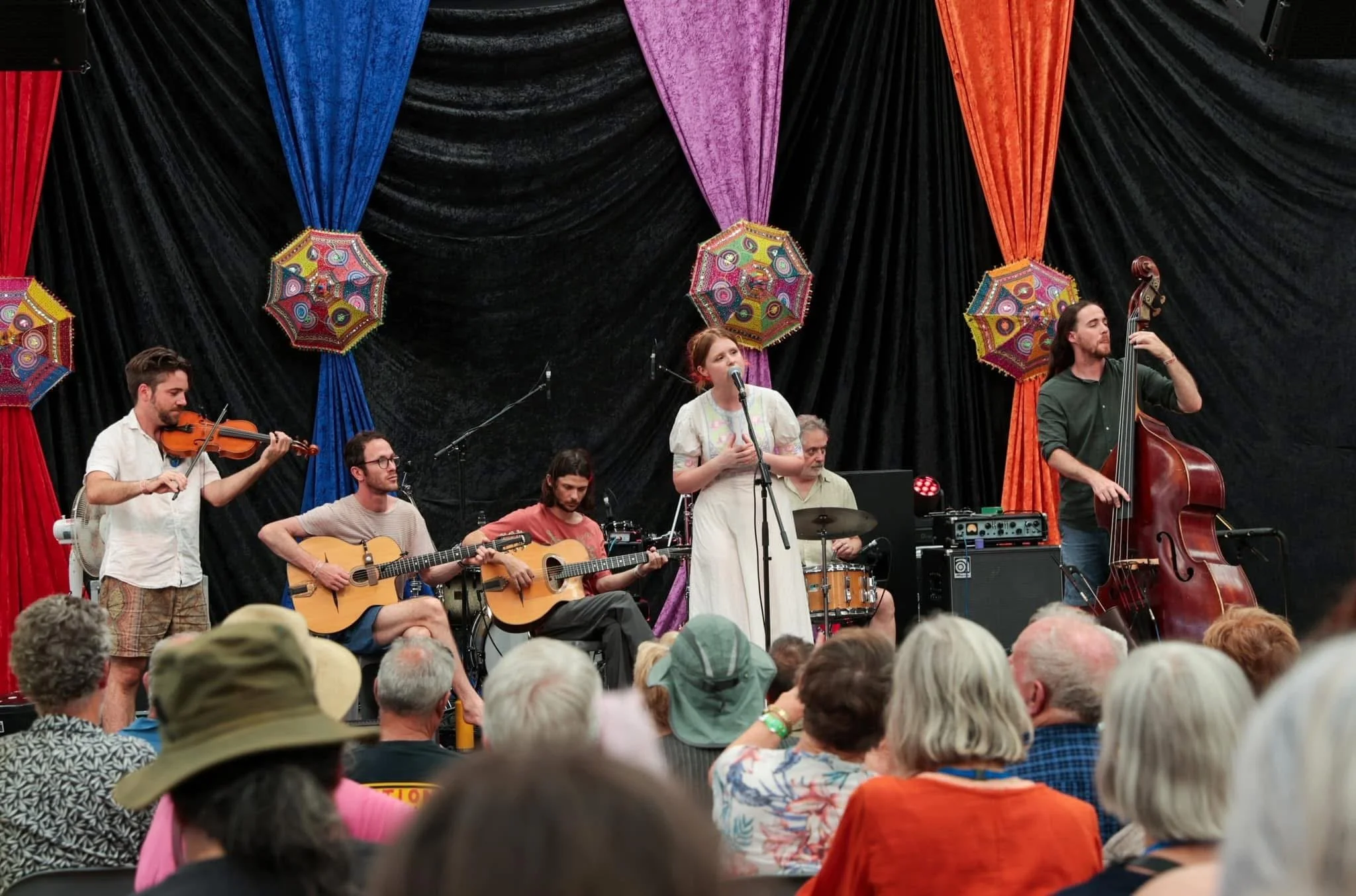
David De Santi’s son Sam has played in many bands, helped with sound production as a teenager and now is part of the highly successful Brisbane-based neo-trad band Amaidi, which performed at the 2026 festival. Highly accomplished fiddle player Gareth Mewes, who played alongside Sam in the children's group Replay and is the son of early shift manager Keith, performs in many festival groups including the popular gypsy jazz band Cigany Weaver. Gareth says: “The Illawarra is the little festival that means the most to me of any in Australia. Growing up here and seeing music from all around the world opened my eyes to all the incredible things I could do with my violin and my life - from Jamberoo pub jams with David and Sam, to mosh pits to the Go Set and Woohoo Revue in the Slacky Flat, to jamming in the campsite till 4am every year. I'll never stop coming back!”
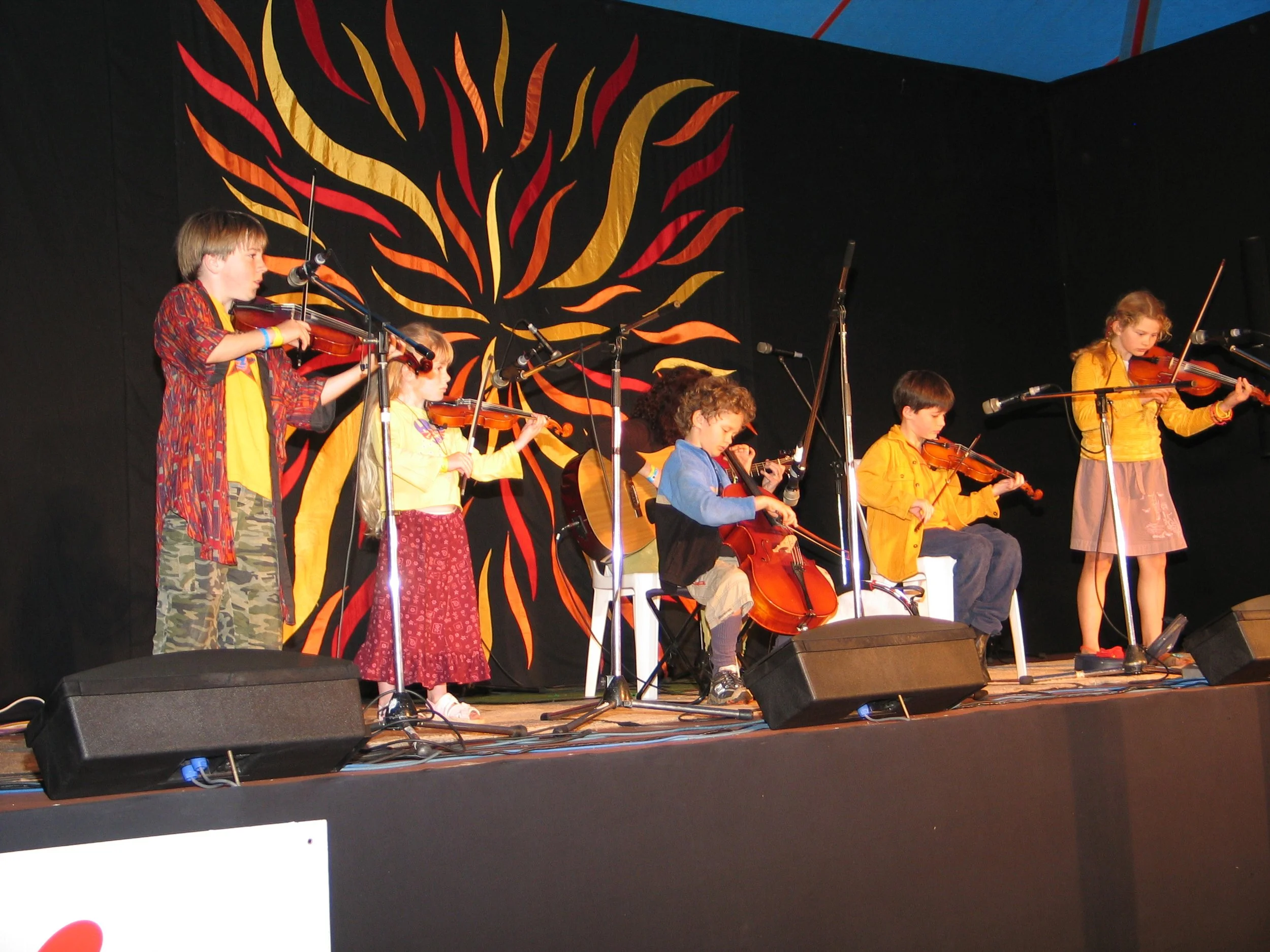
Gareth and Sam both played in Replay as children
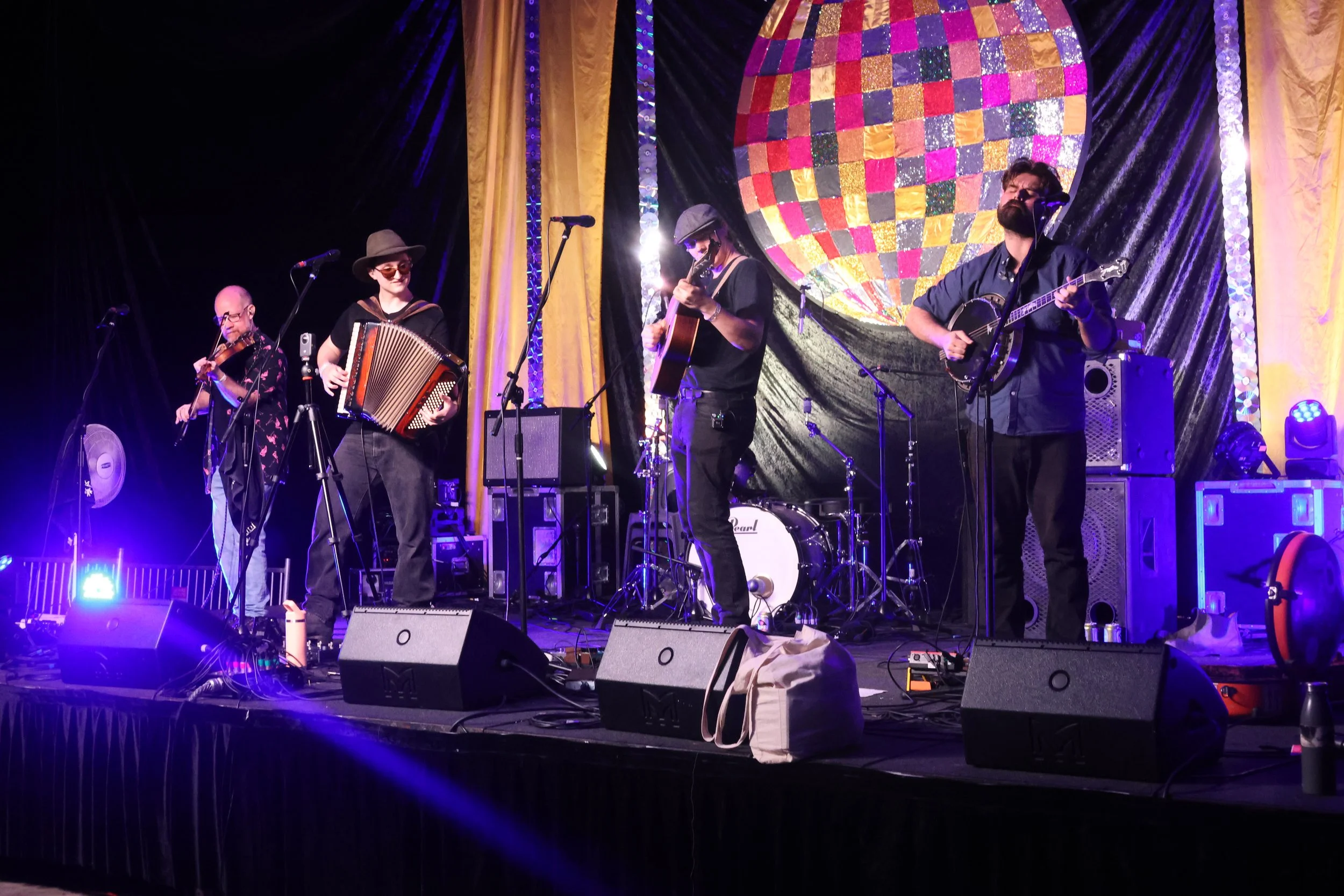
Amaidi 2026, Sam on right
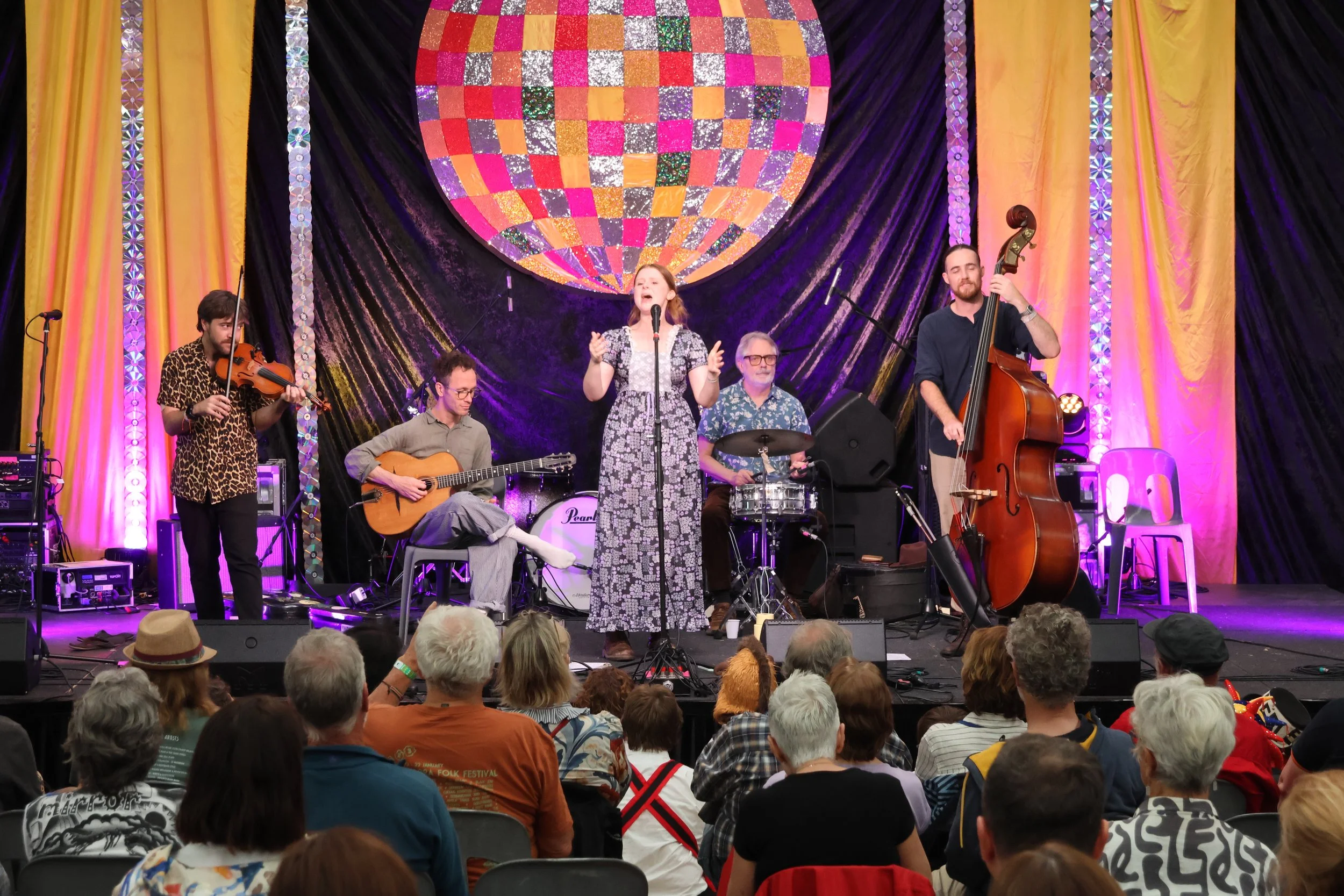
Cigany Weaver 2026, Gareth on left
And it's a great community. Shane says: “Part of the magic of the folk festival is that we're a great community and, you know, extraordinary people giving their time towards it, which is fantastic. I love the community, but we all need to become a part of it and to invest in it for these things to keep going. I love the music involved. I love the diversity of it. I love that it's a wholesome kind of naughty cheekiness that's involved. It's a really great safe festival to be at but it feels a bit naughty staying up till two in the morning and listening to music and all that kind of thing. I have a genuine deep love for the folky.”
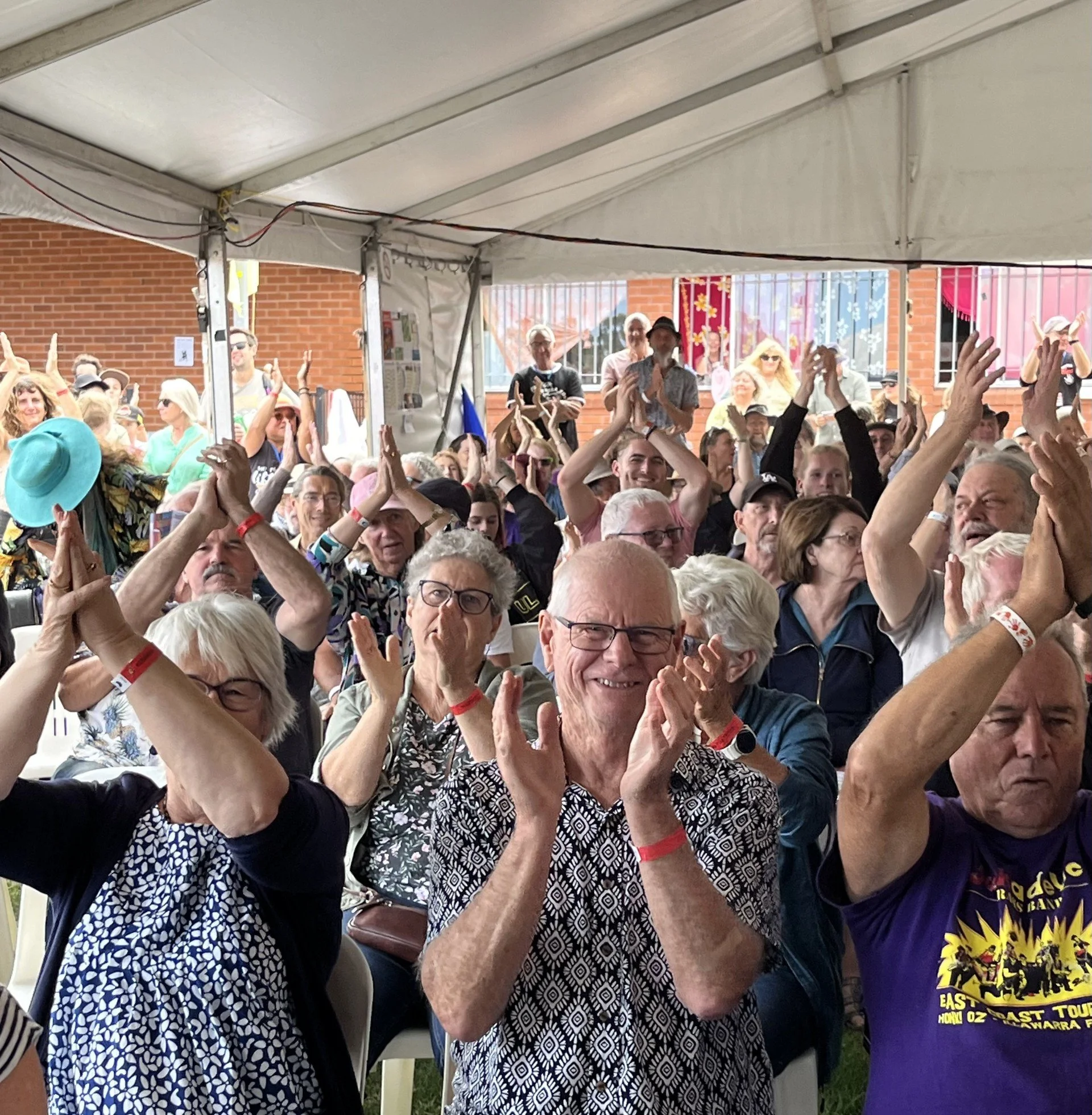
More please! 2026
As have we all. Long live the folky.
See you for our 40th anniversary